Yes. Tell her. Not because you are obligated to, but because keeping it secret is costing you more than the conversation ever will.
Before getting to how, it helps to acknowledge what makes this so hard. The fear is not irrational. Phimosis sits at the intersection of the two things men are least likely to talk openly about: their bodies and their vulnerability. Add a partner whose opinion matters enormously, and the stakes feel impossible. Most men do not tell. They avoid sex, avoid certain positions, avoid getting close, and build an entire private architecture of management around something that does not have to be managed secretly at all.
If you have been living like that, you are not weak. You are doing what the vast majority of men in your position do. But you are also carrying something alone that does not have to be carried alone, and this article is for you.
You Are Not as Alone in This as It Feels
The shame of phimosis is partly the condition and partly the silence around it. When nobody talks about something, it feels like nobody else has it. That is not what the data shows.
A clinical study of men who reached adulthood with untreated phimosis found that 79% had impaired sexual onset, 69% reported significant anxiety, 66% had avoided sex entirely at some point, and 46% had avoided romantic relationships.[1] Nearly half avoided relationships. Not dates. Relationships.
That number is not mentioned to make the situation feel heavier. It is mentioned because it makes the situation feel less singular. The man who has been cancelling intimacy, finding reasons to leave before things progress, sleeping with the light off, or avoiding serious relationships entirely is not unusual. He is the majority, in a condition that is not discussed.
The silence is what makes it feel like a personal failing. It is not. It is a common, treatable medical condition that happens to sit in the most emotionally loaded part of a man's self-image.
What You Are Actually Afraid Of
The fear of telling a partner is usually not one fear. It is several, running simultaneously. It helps to name them separately, because each has a different answer.
The fear of rejection
"She will leave me or lose interest because of this."
What actually happens
Partners almost never end relationships over phimosis. They end relationships over dishonesty, distance, and the feeling that something is being hidden from them. The secret creates more distance than the condition. A partner who stays through a genuine conversation about a medical condition is demonstrating exactly the quality that makes a relationship worth being in.
The fear of humiliation
"She will find it strange, embarrassing, or disgusting."
What actually happens
Most women have very limited knowledge of phimosis specifically. What they encounter is a man being honest about a medical condition they did not know he had. The reaction is almost universally curiosity and concern, not disgust. The version of the conversation you have imagined in your head has been constructed entirely by your own shame, not by anything she has said or done.
The fear of comparison
"She will compare me to other men she has been with."
What actually happens
This fear assumes she is conducting an anatomical assessment she is almost certainly not conducting. Partners in relationships care about connection, care, and presence. The man who is emotionally available and honest is not being measured against a checklist. The man who is distant and evasive is.
The fear of the treatment conversation
"If I tell her, she will want to know what I am doing about it, and then what do I say?"
What actually happens
This is actually the fear with the most useful answer. You tell her you are already treating it. You give her a timeline. A man who is doing something about a problem is not a man with a problem. He is a man who is solving something. That is a completely different conversation, and it has a completely different emotional register for the person you are talking to.
What Partners Actually Say
The accounts from men who have had this conversation are consistent in a way that is worth knowing before you have it. The reaction is almost never what the fear predicted.
"I finally told her after eight months of making excuses. She asked why I hadn't told her sooner. That was it. She was more upset that I'd been carrying it alone than anything else."
Shared in a phimosis community forum
"She looked it up herself that evening. Came back saying she'd found a Reddit thread and had already read about treatment options. She was fully in."
Shared in a phimosis community forum
Partners in relationships generally respond to honesty the way they respond to any disclosure of something personal and difficult: with more empathy than you gave them credit for, and more practical focus on "what can we do" than on "how do I feel about this."
The version of the conversation that plays in your head before you have it is constructed from fear, not from her. The actual conversation will be constructed from her. Give her the chance to show you who she is.
When to Tell Her
There is no perfect moment, but there are better and worse conditions for this conversation.
Not during sex, not immediately before, and not in bed. These are high-stakes physical contexts where she cannot process information in a relaxed way and where you are at your most vulnerable. The conversation will go better in a neutral setting.
Not in public. She needs space to respond naturally without managing how she appears to others.
Not when either of you is tired, stressed, or in the middle of an argument about something else. A straightforward conversation in the wrong emotional context becomes a complicated one.
The best conditions: a quiet moment at home, neither of you distracted or rushed, when the relationship is in a good place. It does not need to be a planned event. It can be a natural transition from a conversation about something adjacent. But it should not be reactive or pressured.
For a relationship that is not yet sexual, the timing is before the first time you have sex together, ideally by at least a few days. Not weeks before, not ten minutes before. A few days gives her time to process it and come back with questions, without it being a conversation that happens at a moment of pressure.
For a relationship that is already sexual, the timing is whenever you are ready to stop carrying it alone. There is no point that is too late for this conversation, only the point at which you are ready to have it.
What to Actually Say: Three Scripts
The words matter less than the tone, but having words helps. These are three versions for three different situations. Read them as starting points, not scripts to memorise.
In an established relationship where sex has already happened
"There is something I have been wanting to tell you for a while. I have a condition called phimosis. It means my foreskin is tighter than it should be. It is why I have sometimes been uncomfortable or pulled back from certain things. It is not dangerous and I am treating it. I just did not want to keep it from you."
After you say it, give her a moment. Do not immediately fill the silence. She may need a second to understand what phimosis is. She may ask questions. Answer them straightforwardly. The conversation usually becomes easier very quickly once she understands it is a medical condition and not something more complicated than that.
In a marriage where she has likely noticed something but has not said so
"I want to talk to you about something I should have told you sooner. I have a condition called phimosis. It is why certain things have sometimes been uncomfortable for me. I know it has probably affected us and I am sorry I didn't say something earlier. I am taking it seriously now and I am treating it."
Wives who have been in relationships long enough to notice something was different, and kind enough not to press, often feel relief at hearing an explanation. The mystery is frequently harder than the reality. The relief she may feel at understanding something that was previously unexplained can come as a surprise.
Before things become sexual for the first time
"Before things go further between us, there is something I want to be upfront about. I have something called phimosis. It means my foreskin is tighter than it should be. It can make certain things a bit different. I am treating it and it is manageable. I just wanted you to know before we got there."
A partner worth being with will respond to this with warmth. A partner who does not is giving you important information about the relationship's future that is better to have now.
What She Will Probably Ask
After the initial disclosure, most partners have variations of three questions. It helps to have thought through your answers before the conversation.
What is phimosis exactly?
The simplest answer: the foreskin is tighter than it should be and cannot retract fully over the glans. It is not a sexually transmitted infection, it is not caused by anything you did or did not do, it is a physical condition some men are born with or develop. It is common and it is treatable without surgery in the majority of cases.
Does it affect sex?
Honest answer: it can. Depending on the severity, sex may be uncomfortable or certain positions or acts may be limited. That changes as treatment progresses. It is worth being honest about what your current experience is rather than minimising it, because she is going to be in the room with the reality regardless.
What are you doing about it?
This is where having started treatment before the conversation is enormously valuable. If you can say "I am already treating it with a stretching protocol and I expect meaningful improvement within the next few months," the conversation has a completely different weight than "I haven't done anything yet." Treatment gives the conversation a direction and a timeline. It turns a disclosure into a shared journey rather than a static problem.
The most important thing you can say about treatment: give her a specific, believable timeline. Not "someday" or "I'm working on it." Something like: "I have been treating it for a few weeks and I am already seeing improvement. I expect to be significantly better within two to three months." Specificity transforms the emotional quality of the conversation.
If She Does Not Respond Well
Most partners respond well. Some do not, at least not immediately. A reaction that is confusing or hurtful in the moment may not reflect her settled position. People sometimes respond to unexpected personal disclosures with the first thing that comes to mind, which is not always the thing they would say if given time to process.
Give her a day. Follow up gently. Most responses that feel cold in the moment soften with time, once the surprise has passed and the reality has been absorbed.
If the response, after time and follow-up, remains genuinely uncaring about something you are actively treating and working through, that is real information about the relationship. A partner who responds to honest, manageable medical vulnerability with sustained coldness is telling you something important about their capacity for partnership. That is painful. It is also better to know.
The fear of the bad response is legitimate. But the cost of never giving her the chance to give you the good one is your relationship, conducted in partial silence, indefinitely.
The Secret Has a Cost You May Have Stopped Noticing
Secrets in relationships do not stay in one place. They spread. The energy that goes into managing what she does not know becomes the energy that is not available for the relationship itself. The distance created by one kept thing gradually becomes the texture of the whole relationship. Partners feel it even when they cannot name it.
The men who describe having this conversation almost all say the same thing: they wish they had done it sooner. Not because the conversation was easy, but because the relief of it was so much larger than they expected. The thing that felt like the most dangerous possible moment turned out to be one of the more connecting ones.
That is not guaranteed. Nothing about relationships is guaranteed. But it is the far more common outcome than the one your fear has been showing you.
Before the Conversation: Start Treatment First
The single thing that changes the emotional quality of this conversation more than anything else is whether you are already in treatment. A man who says "I have phimosis and I am treating it" is in a fundamentally different position than a man who says "I have phimosis." One is a condition. The other is a journey with a direction.
If you have not started treatment yet, starting now means that by the time you have the conversation, you have already been working on it. You have numbers. You have progress. You have something concrete to show for the courage it took to address it.
Treatment for most grades of phimosis does not require surgery, does not require a doctor's appointment to begin, and does not require anything to be visible to anyone. It happens privately, at home, with consistent daily practice. Most men with Grades 2 through 4 see measurable progress within four to eight weeks.
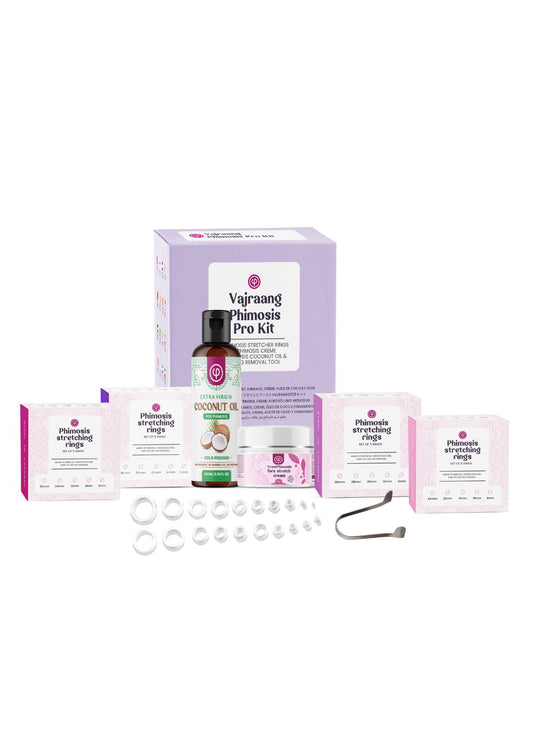
Vajraang Phimosis Stretching Rings Kit: the at-home treatment protocol for Grades 1 to 4
20 graduated ring sizes from 3mm to 38mm. Daily sessions of thirty to forty-five minutes, twice daily. Most men see first measurable ring size advancement within two to three weeks of daily use. The progression is trackable, which means you can tell her specifically how far you have come.
View the Rings KitNot sure where you are starting from? Take the free assessment first
The Vajraang self-assessment identifies your Kikiros grade and gives you a personalised starting protocol with a realistic timeline. If you want to tell her "I am at Grade 3 and I expect to reach Grade 1 within twelve weeks," this is where that number comes from.
Take the free assessment20 questions · Kikiros grade · Personalised protocol · Realistic timeline
Begin the assessmentFrequently Asked Questions
Should I tell my girlfriend I have phimosis before we have sex for the first time?
Yes, and a few days before rather than immediately before. Telling her before gives her time to process it without feeling pressured, ask questions without it being loaded, and come back to the conversation from a calmer place. A disclosure that happens immediately before a sexual moment puts both of you in an unnecessarily high-stakes position. A few days of lead time turns it into a conversation between equals rather than a confession under pressure.
What if she has no idea what phimosis is?
Most partners do not. You can explain it simply: the foreskin is tighter than it should be and does not retract fully over the head of the penis. It is a physical condition, not an infection, not caused by anything either of you did. It affects intimacy in certain ways depending on severity. You are treating it. That is enough for most partners to understand the relevant parts without needing a clinical explanation.
I am married and have never told my wife. Is it too late?
No. There is no point in a relationship at which honesty about something real becomes more damaging than continued silence. If anything, the longer it has gone unsaid, the more relief there often is on both sides when it is finally said. The conversation may need to include an acknowledgment that you wished you had said it sooner. That is fine. It is honest. Marriages hold a great deal more than men in this situation typically give them credit for.
What if she asks whether I have been to a doctor?
Answer honestly. If you have, say so. If you have not but you are treating it at home with a proven conservative protocol, you can say that and explain what you are doing. The important thing is that she sees you are taking it seriously and treating it systematically, not leaving it unaddressed. Active treatment is the part of this conversation that most changes the emotional quality of it for a partner.
Can I wait until after treatment to tell her?
You can. Some men prefer to reach a certain stage of treatment before disclosing. The advantage is that you can tell her "I had this and I have treated it" rather than "I have this and I am treating it." The disadvantage is that you continue to carry the secret for the weeks or months it takes to reach resolution, and your partner continues to experience whatever distance that secret creates without understanding why. Most men who have done it both ways say they wished they had told her earlier.
How do I explain why I did not tell her sooner?
The truth is the right answer. It felt too embarrassing to bring up. You were not sure how she would respond. You kept waiting for the right moment. You did not know how to say it. These are completely understandable human reasons and a partner who genuinely cares about you will recognise them as such. You do not need a sophisticated explanation. You need an honest one.
- Gerbaud-Coulas M, et al. Onset of sexuality is impaired in young men with a persistent congenital phimosis. European Urology Focus. 2022. View study. Source of data on anxiety, relationship avoidance, and sexual onset impairment in men with untreated phimosis.