No. Do not give up. Two weeks of stretching with no visible change is completely normal. It is not a sign the treatment is failing. It is a sign your body is in the early adaptation phase, doing invisible biological work that makes visible change possible from week three onwards.
This moment, two weeks in with nothing to show, is the single most dangerous point in the entire phimosis treatment journey. It is where the majority of men quit. Not because the treatment stopped working. Because they stopped doing it before the biology had a chance to produce visible results.
You are sitting at exactly the moment where the biology is transitioning from invisible preparation to visible result. This article explains what is happening in your tissue right now, gives you a five-point protocol audit, and shows you the specific adjustments that produce first results within days.
The Biology: Why Two Weeks Produces No Visible Change

When the foreskin is subjected to consistent gentle stretching, the body runs a biological response called tissue expansion. This is not a vague metaphor. It is a specific sequence of cellular events driven by two primary mechanisms: mechanoreceptors in the foreskin skin detecting the applied tension and triggering new cell division, and fibroblasts synthesising collagen to build new elasticity into the expanding tissue.[2]
The critical fact for understanding your two-week experience: the collagen remodelling phase, where new collagen is laid down and the tissue gains measurable physical elasticity, begins at week two to three.[3] Everything before that is cellular preparation. Visible change follows remodelling, not preparation.
You are not behind. You are at the exact transition point between preparation and result. The men who succeed are the men who stay consistent through this transition.
Mechanoreceptors activate
Skin mechanoreceptors detect the tension. They signal the body that expansion is occurring and new cells are needed. Nothing is visibly different. The process has started.
Fibroblasts activate and begin collagen production
Fibroblasts, the cells that build connective tissue, proliferate and begin synthesising collagen. Extracellular matrix forms. New blood vessels grow to supply expanding tissue. Not visible from outside. You were here between day 7 and day 14.
Collagen remodelling starts: first measurable change approaching
Collagen fibres reorganise along tension lines. Type III collagen (temporary scaffolding) converts to Type I collagen (permanent elastic tissue). First measurable change typically appears here. This is the phase men quit in, days before results begin.
Visible, measurable improvement
Retractability improves measurably. Rings advance to next sizes. The tissue built in weeks one to three now shows as functional flexibility. This is one consistent week away from where you are.
The key fact: the men who quit at week two never find out they were three to seven days from first visible change. The biology does not care about your feelings about the timeline. It only cares whether the daily stimulus continues.
The Protocol Audit: Five Things to Check Before Anything Else
Genuine consistency at two weeks with no change at all is normal. But sometimes "I have been consistent" and "the protocol has been correct" are two different things. Before adjusting anything, run this audit honestly.

| Audit point | What correct looks like | Common gap | Impact if missed |
|---|---|---|---|
| Warm compress | 2 to 3 minutes of warm flannel against the foreskin before every single session, no exceptions | Skipping warm-up entirely, or doing it once every few sessions | High Cold tissue resists expansion significantly. This one change alone often produces first results within days of adding it. |
| Cream placement | A small amount applied directly to the phimotic band, the tight ring of tissue at the foreskin opening, massaged in for 30 seconds before the stretch | Applying cream generally across the foreskin surface, or not using it at all | High The cream needs to contact the specific tissue being stretched. General application delivers minimal benefit to the phimotic band. |
| Session frequency | Every single day without gaps. Two sessions daily is better than one. | 4 to 5 sessions per week, with 2 to 3 days off each week | High The collagen remodelling cycle requires continuous daily signals. Gaps interrupt the cycle. 4 sessions per week over 2 weeks is only 8 to 10 actual sessions, not 14. |
| Targeting accuracy | The stretch specifically expands the phimotic band, the ring at the foreskin opening. The ring or fingers apply outward radial pressure there. | General retraction or pulling without specifically targeting the tight band | Medium Effort without direction. The tissue that needs expansion is not receiving the mechanical stimulus. |
| Baseline record | Starting ring size, starting Kikiros grade, or a dated photo documenting retractability at day one | No baseline. No documented starting point to compare against. | Medium Progress at weeks two and three is measured in millimetres. Without a reference, real progress is invisible. Men conclude nothing is happening when changes have already occurred. |
If any of the first three rows is a gap in your practice, fix it today. The warm compress and daily cream on the phimotic band together are the two changes most commonly responsible for breaking a perceived plateau at week two.
What Real Progress Looks Like at Week Two
The most common mistake at this stage is measuring progress with the wrong instruments. Week two progress is not visible in dramatic retraction improvement. It shows in subtle signals that the tissue is adapting. Learn to read those signals.

- Sessions feel slightly less uncomfortable than day one
- The same ring size that was snug now enters more easily
- Post-session redness fades faster than in week one
- Stretching feels like tension rather than sharp resistance
- Tissue feels marginally softer immediately after a session
- Ring does not feel as tight as it did in the first few days
- Visible increase in retractability
- Ability to advance to the next ring size
- Dramatic change in foreskin appearance
- Pain-free erections if they were painful before
- Any change noticeable to a partner
- Change visible in a photograph taken today
If you notice any signal in the left column, your treatment is working. You are measuring with the right instruments. Continue without doubt.
The Four Real Reasons Men Quit at Week Two
The published literature on phimosis treatment is unambiguous on one point: treatment failure is almost always a compliance failure, not a tissue failure.[1] The tissue responds when the practice is consistent. Understanding why men stop at week two specifically is useful because those reasons are not about tissue, they are about psychology.
Expectation mismatch
Men expect visible change in two weeks because that is what they hope for, not what the biology produces. When reality does not match hope, the instinct is to interpret normal as failure. The biology has not failed. The expectation was wrong from the start.
No baseline to compare against
Without a documented starting point, subtle real progress is completely invisible. Men cannot see what they are not measuring. Progress at week two is in millimetres and comfort differences. A man with no baseline genuinely cannot detect it, and concludes nothing is happening.
Isolation and silence
Most men do this entirely alone. There is nobody to say "week two is normal, keep going." No community, no accountability, no external voice that confirms the experience is universal. That silence is misread as confirmation that something is wrong specifically with them.
Accumulated shame and exhaustion
Two weeks of daily effort on a condition that has carried shame for years, with nothing visible to show, is genuinely hard emotionally. The temptation to interpret no visible progress as final confirmation that nothing will ever change is understandable. It is also incorrect.
The Week Two Adjustments: What to Change Right Now
If your self-audit found gaps, here are the specific adjustments ranked by impact. Apply them from today, maintain them consistently, and expect first measurable change within seven to ten days.
Add the warm compress if you have been skipping it. Two to three minutes of a warm flannel against the area before every session. This is the single most impactful change for men who have been stretching cold. Warm tissue yields to mechanical tension. Cold tissue resists it. This adjustment alone, applied consistently, frequently produces first visible change within a week.
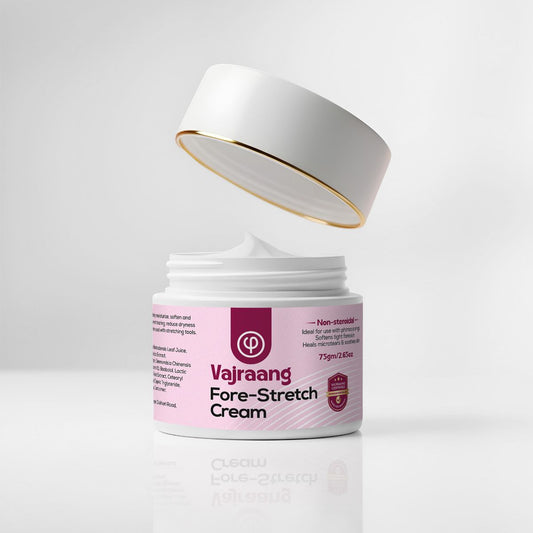
Move the cream to the phimotic band specifically. Apply a rice-grain-sized amount directly to the tight ring at the foreskin opening. Massage it in for thirty seconds before starting the stretch. If you have been applying it broadly, redirect it now. The band is the target. The cream must contact it.
Move from once daily to twice daily. Morning and evening, ten to fifteen minutes each. The collagen remodelling cycle responds to cumulative signals. Two sessions per day give the tissue twice the biological input in the same time period. This is the fastest protocol upgrade available.
Start a session log today. Current ring size and a comfort score from one to five after every session. One sentence. The act of logging makes week three progress visible when it would otherwise go unnoticed. Many men who felt no progress in week two find, looking back at their log in week four, that measurable changes started exactly where the biology predicts.
Create a baseline right now if you do not have one. Record today's current ring size or describe your current retractability using the Kikiros grade descriptions. Date it. You will compare against this in two weeks. Without it, you cannot see progress that is already happening.
Not using rings yet? This is where rings become more effective than manual stretching alone
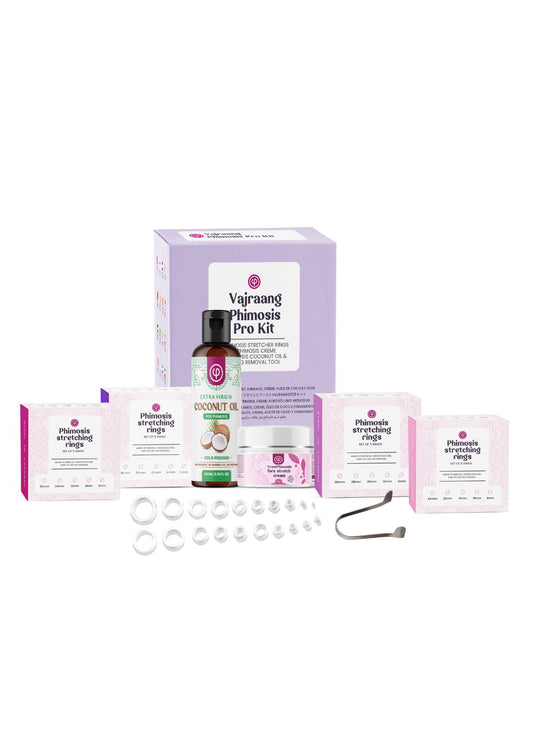
The Vajraang Rings Kit provides consistent, measurable radial expansion at the phimotic band for thirty to sixty minutes per session. Unlike manual stretching, which is difficult to maintain at consistent pressure, rings maintain constant tension throughout the session. At week two, switching from manual-only to rings typically produces the first ring size advancement within one week. Each size advancement is a measurable, documented data point.
View the Rings KitGrade 4 or 5? The GlanPro tool is the starting point before rings are possible
For pinhole or severe phimosis where rings cannot yet be inserted, the GlanPro tool provides targeted expansion using adjustable stainless steel arms. Two weeks of GlanPro use at this grade typically creates enough opening for the smallest rings to begin. Progress is visible because the tool gap width is measurable every session.
View the GlanPro ToolThe Escalation Ladder: Two Weeks vs Ten Weeks
There is a critical distinction between two weeks of no visible progress, which is completely normal, and ten to twelve weeks of correct consistent practice with no measurable change, which is genuinely worth reassessing. Use this table to understand exactly where you are on the escalation spectrum.

| Timeframe | Expected situation | Status | What to do |
|---|---|---|---|
| Weeks 1 to 2 | No visible change. Subtle comfort signals only. Tissue in preparation phase. | Normal | Continue. Apply the audit adjustments. Do not reassess treatment yet. |
| Weeks 3 to 4 | First measurable change typically appears for Grades 2 to 4. Ring comfort improving or first size advancement. | Expected progress | If no change, run the five-point audit again. Identify and fix any remaining gaps. |
| Weeks 5 to 8 | Primary progress window. Meaningful retractability improvement and ring advancement should be visible. | Watch | If stalled, consider adding prescription betamethasone alongside stretching. Consult a urologist for a prescription. |
| Weeks 9 to 12 | No measurable change after twelve weeks of genuine consistent daily practice. | Reassess | See a urologist. Rule out BXO. Discuss prescription topical steroids. Reassess Kikiros grade. Consider preputioplasty if conservative treatment is not producing results. |
You are at week two. You are in the green row. You are not in escalation territory. You are not even close. The first measurable change typically appears one to two weeks from exactly where you are right now.
For a full breakdown of what to expect at every stage, read the complete week-by-week treatment timeline.

20 questions · Your starting ring size · Step-by-step recovery plan
Begin the assessmentFrequently Asked Questions
I have been stretching for 2 weeks and nothing has changed. Is the treatment not working?
No change at two weeks is completely normal and expected. The collagen remodelling phase, where measurable tissue elasticity develops, begins at week two to three, not day one.[3] You are at the threshold of visible change, not at the point of treatment failure. The men who succeed are the men who stay consistent through this exact moment.
How do I know if my phimosis stretching is actually working if I cannot see results?
At week two, look for subtle signals: sessions feel slightly less uncomfortable than week one, the same ring size enters more easily, post-session redness fades faster, stretching feels like tension rather than sharp resistance. These are real, measurable progress signals. Visible retractability improvement typically begins at weeks three to four for Grades 2 to 4.
What is the single most impactful change I can make right now?
Add the warm compress if you have been skipping it. Two to three minutes of warmth before every session increases tissue elasticity before the stretch begins. It is the most commonly skipped step and the one whose absence most reliably limits early progress. If you have been stretching without warming first, this single adjustment often produces first visible change within one week of implementing it consistently.
What is the most common reason phimosis treatment fails?
Non-compliance with the daily protocol. The Orsola 2000 study reporting 90% success at six months found that every treatment failure in the cohort occurred in men who did not maintain the daily practice.[1] The tissue responds when the practice is consistent. It cannot respond when the practice is inconsistent.
When should I actually be concerned that treatment is not working?
Two weeks is far too early to assess. The appropriate reassessment window is eight to twelve weeks of genuine daily consistency. No measurable change after twelve consistent weeks is the point at which a urologist consultation is warranted to assess BXO, consider prescription betamethasone, and re-evaluate Kikiros grade.
Can I do anything to speed up progress at week two?
Yes. Move to twice daily sessions if you have been doing once. Add the warm compress. Confirm cream is applied to the phimotic band specifically. Start logging ring size and comfort score after every session. These four adjustments together typically produce first visible results within seven to ten days of consistent application.
Is there any situation where stopping at week two is the right call?
Yes: persistent pain that does not reduce after sessions, redness lasting more than two hours, visible tears not healing, or signs of infection. These are signals to rest and reduce pressure, not to stop permanently. Read the guide on pain during stretching for the specific rest and recovery protocol before resuming.
- Orsola A, Caffaratti J, Garat JM. Conservative treatment of phimosis in children using a topical steroid. Urology. 2000;56(2):307-310. PMID 10925099
- StatPearls. Wound Healing Phases. NCBI Bookshelf. NBK470443
- ScienceDirect. Remodeling Phase overview. View source
- Zampieri N, et al. Phimosis: stretching methods with or without topical steroids. J Pediatr. 2005;147(5):705-6. PMID 16291369