The feeling that you are improving but cannot confirm it is one of the most common and most demoralising experiences in phimosis treatment. You are not imagining progress. You simply have no measurement system. This article gives you one.
Three tools together form a complete measurement framework: the Kikiros retractability grade (your clinical position on a six-point scale used in published research), ring size progression (the most granular and objective daily measure available), and the weekly comfort score (a subjective but consistent indicator that catches improvement before it is visually obvious). Used together from a documented baseline, these three numbers tell you precisely where you are and how far you have come.
The reason most men cannot answer "am I making progress?" is not because they are not making progress. It is because they started with no baseline. Progress is always measured as a delta. Without a starting point, there is no delta to measure.
Step One: Establish Your Kikiros Grade
The Kikiros scale is the clinical grading system used in peer-reviewed phimosis research globally, including the studies that established betamethasone plus stretching as the standard conservative treatment protocol.[1] It has six grades from Grade 5 (no retraction at all) down to Grade 0 (full retractability).
Assess yourself against each description and identify your starting grade today. Write it down with today's date. This is your clinical baseline.
The foreskin opening cannot be moved back at all. The tip is fully closed. Rings cannot yet be inserted. The GlanPro tool is the appropriate starting device at this grade.
SevereThere is some movement of the foreskin tip but neither the urinary meatus nor the glans can be exposed. Some distance between the foreskin tip and the glans.
SevereThe foreskin can be pulled back enough to expose the urinary opening but the glans remains covered. This is the most common starting grade among men who begin stretching.
ModerateThe foreskin retracts enough to partially expose the glans head. Full exposure is not yet possible. This grade is sometimes not identified as phimosis by the person, who assumes the situation is normal.
Mild to moderateThe foreskin can be fully retracted to expose the glans but a tight ring constricts behind the glans head. Risk of paraphimosis at this grade if retracted during erection. Stretching focuses on loosening this residual ring.
MildThe foreskin retracts fully and comfortably in both flaccid and erect states with no constriction. This is the treatment goal.
ResolvedEach grade change is a clinically significant milestone. Moving from Grade 4 to Grade 3 is measurable, documented progress even if it does not feel dramatic. Clinical studies use this exact scale to define treatment success.[2] You are now using the same measurement tool.
Write down today: your Kikiros grade, today's date. Reassess every four weeks. A single grade change in four weeks is normal and meaningful progress.
The Three-Method Measurement Framework
The Kikiros grade gives you your clinical position. But it changes slowly, sometimes monthly. For weekly tracking, you need two additional measures that are more granular. Together these three form a complete picture.
Ring size progression
This is the most objective and granular measurement available for men using the Vajraang Rings Kit. Each ring in the set is a specific diameter in millimetres. The ring you can currently insert and wear comfortably is your current ring size. The ring that is still too tight to insert is your next target.
Record your current comfortable ring size every session. When the ring that used to require effort now slides in easily and stays loose, you advance to the next size. That advancement is a measurable, undeniable data point.
Why this works: Ring sizes progress in small, consistent increments. This makes it possible to detect progress of two to three millimetres that would be completely invisible in any other measurement method. Most men advance one to two ring sizes per week during active progress phases.
Baseline entry: "Current ring size: [XX]mm. Cannot yet insert [XX+1]mm." : date this and revisit weekly.Retractability score at assessment
Once per week, after a warm shower when tissue is most relaxed, assess your retractability against the Kikiros descriptions above. Score yourself from 0 to 5. This is your weekly retractability score.
Do not assess during stretching sessions. Assess separately, under consistent conditions, at the same time of day. Consistency of conditions is what makes comparison valid.
What to look for between whole grades: Progress does not always jump a full Kikiros grade in a single week. Within each grade, you will notice intermediate changes: the foreskin goes slightly further back than last week, or full retraction to your current grade requires noticeably less effort. These sub-grade improvements are real progress and are worth recording.
Baseline entry: "Kikiros Grade [X]. Retraction feels: [description]." : reassess same conditions every 7 days.Weekly comfort score
After each session, rate the comfort of stretching on a scale from 1 to 5. One means significant discomfort or resistance. Five means the stretch feels like gentle tension with minimal resistance. Use the same definition each time.
This score catches progress before it is physically visible. In the early weeks, comfort improves before retractability improves. A rising comfort score at the same ring size is a leading indicator of approaching physical progress. It is the signal that the tissue is softening and remodelling.
Pattern to watch: if your comfort score at a given ring size rises from 2 to 4 over two weeks without advancing to the next size, you are close to advancing. The tissue has adapted to that size. Advancement is imminent.
Baseline entry: "Comfort score: [1-5]. Ring: [XX]mm." : log after every single session.The Weekly Log Format
One row per session. Four columns. Takes thirty seconds. This is the minimum viable log that generates the data you need to answer "am I making progress?" with certainty.
| Date | Ring size (mm) | Comfort score (1-5) | Retractability note |
|---|---|---|---|
| Day 1 (baseline) e.g. 1 Mar |
e.g. 14mm comfortable, 16mm too tight | e.g. 2 : notable resistance | e.g. Grade 3. Meatus just visible on full push |
| Week 1 e.g. 8 Mar |
e.g. 14mm easy, 16mm snug but enters | e.g. 3 : less resistance | e.g. Same grade, slightly easier |
| Week 2 e.g. 15 Mar |
e.g. 16mm comfortable, 18mm target | e.g. 4 : mostly comfortable | e.g. Grade 3, slightly more retraction |
| Week 4 e.g. 29 Mar |
e.g. 18mm comfortable, 20mm target | e.g. 4 at new size | e.g. Grade 2. Partial glans exposure now visible |
The pattern in the example above is exactly what steady progress looks like. Ring size advanced from 14mm to 18mm in four weeks. Comfort score rose and then reset lower when advancing to a new ring (which is correct and expected). Kikiros grade moved from 3 to 2. Every single column shows forward movement. Without the log, all of this would feel like nothing was happening.
The most important insight from logging: the moment men start measuring, they almost always discover they were already making progress. The problem was never the treatment. The problem was the absence of a record to compare against.
What Real Progress Milestones Look Like
Use these as your reference checkpoints. Each one is a milestone worth recording on the date it happens.
Comfort score rises at the same ring size
The ring you started with now feels noticeably easier. Resistance has reduced. You have not advanced yet but the tissue is adapting. This is the first measurable change and it is real.
First ring size advancement
The next size up, which was previously too tight to insert, now enters with manageable resistance. You have your first millimetre measurement of expansion. This is where the log pays off most visibly.
First Kikiros grade change
Your weekly retractability assessment shows you have moved down one grade on the Kikiros scale. If you started at Grade 4, you can now see the meatus (Grade 3). If you started at Grade 3, you can now see partial glans (Grade 2). This is the clearest signal the treatment is working.
Functional retraction improvement
Day-to-day activities feel different. Cleaning is easier. Ballooning during urination has reduced or stopped. Erections are less uncomfortable. These functional changes are direct evidence of structural progress and they matter as much as the numbers.
Full retraction flaccid (Grade 0)
The foreskin retracts fully and comfortably when the penis is flaccid. For men who started at Grade 3 or above, this is the primary treatment goal. Grade 1, retraction during erection, often follows within two to four weeks of reaching Grade 0 flaccid.
Why Ring Size Is the Most Reliable Daily Measure
Of the three measurement methods, ring size progression is the one that gives you a number every single session. It does not require comparison memory or subjective judgment. The ring either fits or it does not. When it fits where it did not before, that is a number that does not lie.
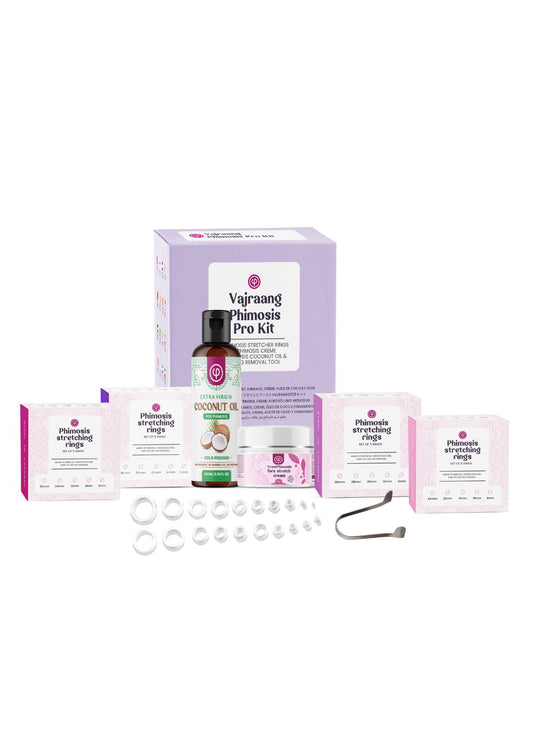
The Vajraang Rings Kit contains 20 rings progressing from 3mm to 38mm in small, consistent increments. This range covers every grade of phimosis from pinhole Grade 5 through to Grade 1. Each ring advancement represents a specific, measurable increase in the diameter of the phimotic band opening.
For context on what the numbers mean physically: the difference between a Grade 4 and a Grade 3 on the Kikiros scale corresponds roughly to an opening wide enough to expose the urinary meatus, which in most men occurs somewhere in the 14mm to 20mm ring range. The difference between Grade 2 and Grade 1 typically corresponds to rings in the 24mm to 32mm range. These are approximate and individual variation exists, but the ring size log gives you the real numbers for your own anatomy.
The Vajraang Rings Kit: 20 sizes, 3mm to 38mm, every grade covered
Each ring in the kit is a numbered, fixed diameter. Your current comfortable ring size is your daily measurement baseline. Advancement to the next size is your weekly progress marker. Without fixed, numbered sizes, ring size progression cannot be tracked. This is why a graduated kit matters for measurement as much as for stretching.
View the Rings KitStarting at Grade 4 or 5? The GlanPro gives you measurable numbers before rings are possible
For severe phimosis where rings cannot yet be inserted, the GlanPro tool provides expansion via adjustable stainless steel arms. The arm gap width is measurable with each session. An increasing gap width is your daily progress number at this grade, equivalent to ring size advancement at milder grades. Most men using the GlanPro reach a size where the smallest rings can be inserted within two to four weeks, at which point both measurement systems can be used together.
View the GlanPro ToolThe Photo Method: Optional but Powerful
A photograph taken every two weeks under consistent conditions provides a visual record that complements the numbers. Many men find that visual comparison across a four to six week period shows changes they genuinely could not perceive from memory alone.
The protocol is simple: same position, same lighting, same level of retraction attempt, every two weeks. Date each photo in the filename. Compare photo from today against photo from four weeks ago, not against yesterday. Four weeks gives the tissue enough time to show changes that are visible in a photograph.
The photo method is especially useful at Grade 2 and Grade 3, where changes in how much of the glans is exposed are visually clear in comparison but not always obvious in the moment. It is less useful at Grade 5 and Grade 4, where the visual change is minimal until a Grade shift occurs.
One important note: do not compare today's photo against last week's. Progress at this scale is not visible week to week. The comparison interval that produces visible evidence is four weeks minimum. Comparing too frequently leads to the false conclusion that nothing is happening.
What to Do If Your Numbers Are Not Moving
If you have been logging consistently for three to four weeks and all three measures are genuinely flat, that is information. It points to one of four things, in order of likelihood.
- The warm compress is being skipped. Cold tissue resists expansion significantly more than warm tissue. If you are not warming for two to three minutes before every session, this alone is enough to stall measurable progress. Add it and log the change.
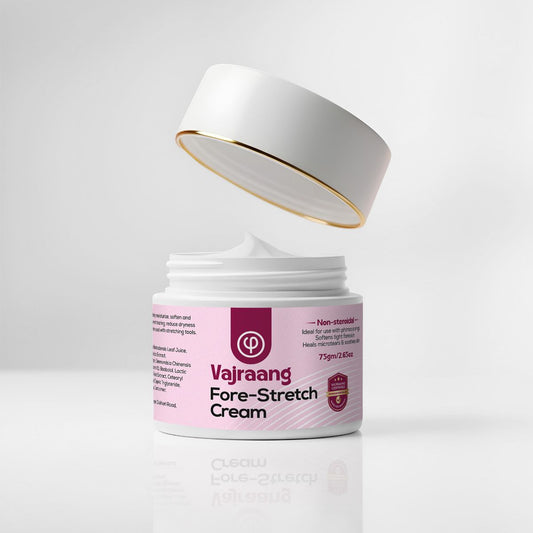
- The cream is not reaching the phimotic band. A small amount applied directly to the tight ring of tissue, not to the general foreskin surface, massaged in for thirty seconds before stretching. If the cream is going anywhere else, it is not doing what it needs to do.
- Sessions are not daily. Four or five days per week feels consistent but it breaks the cumulative signal that drives collagen remodelling. Daily consistency matters more than session length. Shorter daily sessions outperform longer irregular sessions.
- The ring size is wrong for the current grade. If the ring is too loose, there is no tension and no stimulus for expansion. If it is too tight, it causes damage rather than productive stretch. The correct ring is one that fits snugly with mild resistance, not pain. Reassess which size you should be using.
If all four of those are already correct and numbers are still flat after eight to ten weeks, that is the appropriate point to involve a urologist. It may indicate the need for prescription betamethasone, assessment for BXO, or a grade reassessment. Two to three weeks of flat numbers is not that point. Eight to ten weeks of correct consistent practice with no movement is.
Share your numbers with men at the same grade in the Vajraang Private Channel Grade-specific progress tracking, protocol questions, and real timelines from real treatment journeys.20 questions · Kikiros grade · Starting ring size · Recovery timeline
Begin the assessmentFrequently Asked Questions
How do I know if my phimosis treatment is actually working?
Track three numbers: your Kikiros grade (assessed monthly against the six-point retractability scale), your current comfortable ring size (logged every session), and your weekly comfort score at a fixed ring size (logged after every session). If any of these three is improving over a four-week period, your treatment is working. Most men find that when they start measuring, they discover progress they could not see without a record.
What is the Kikiros scale and how do I use it?
The Kikiros scale is a six-grade clinical classification system for phimosis severity used in published medical research worldwide.[3] Grade 5 is no retraction at all. Grade 0 is full retractability. Assess yourself against the grade descriptions in this article, write down your grade with today's date, and reassess every four weeks under consistent conditions. A single grade change in four to eight weeks of consistent treatment is normal and meaningful progress.
How often should I measure my progress?
Ring size and comfort score: every session, takes thirty seconds. Kikiros grade: once per week, after a warm shower. Photo comparison: every four weeks minimum. Do not attempt to assess Kikiros grade progress daily. The changes are too small to detect that frequently and daily self-assessment produces false negatives that undermine motivation.
What ring size should I expect to be using at each Kikiros grade?
Approximate ranges based on anatomical averages: Grade 5 (pinhole), GlanPro only before rings are possible. Grade 4, typically 6mm to 14mm rings. Grade 3, typically 14mm to 22mm rings. Grade 2, typically 20mm to 30mm rings. Grade 1, typically 28mm to 36mm rings. These are approximate. Your own anatomy determines the precise ring sizes. Track your actual ring size against your actual Kikiros grade rather than relying on these estimates.
Is a photo comparison a reliable way to track progress?
Yes, with one condition: the comparison interval must be at least four weeks. Week-to-week photo comparison almost never shows visible change because the structural changes are happening at the tissue level, not the surface level, in early weeks. Four-week comparisons under consistent conditions frequently show changes that are visually clear and that men genuinely could not perceive from memory. The photo method works best as a supplement to numerical tracking, not as a standalone measure.
My ring size and comfort score are not moving after three weeks. What should I do?
Check four things in order: warm compress before every session (two to three minutes, non-negotiable), cream applied directly to the phimotic band and not the general foreskin surface, sessions happening every single day rather than four to five times per week, and ring size correctly matched to current grade (snug resistance, not pain, not loose). Correcting any one of these typically produces measurable movement within one week. If all four are already correct and numbers are flat at ten to twelve weeks, consult a urologist.
- Castiglione F, et al. Can circumcision be avoided in adult male with phimosis? Results of the PhimoStop prospective trial. PMC 2021. PMC8661253
- Cuckow PM, et al. Predictive power of objectivation of phimosis grade on outcomes of topical betamethasone treatment. J Urol. 2012. PMID 22749426
- Shahid SK. Phimosis in Children. PMC. 2012. PMC3329654
- Kikiros CS, Woodward AA. Retractability grading of phimosis. Referenced across multiple clinical trials as the standard classification instrument for phimosis severity assessment.