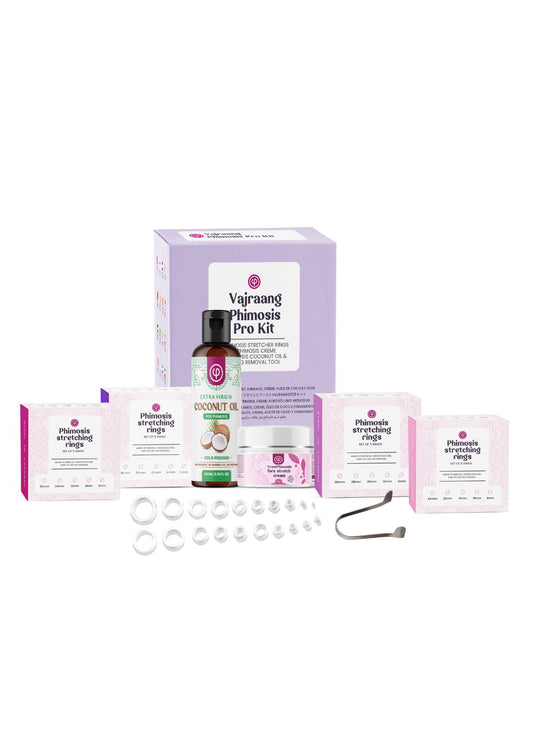
Every option does a different job. Betamethasone temporarily softens collagen to accelerate early progress. Coconut oil lubricates and prevents infection during sessions. The Vajraang creams rebuild tissue elasticity and repair microtears throughout the treatment period. Using the right one at the right stage is not a minor detail. It determines how fast you move.
The confusion around phimosis creams is predictable. Men get prescribed betamethasone by one doctor, read about coconut oil on a forum, see Vajraang cream recommended elsewhere, and have no framework for understanding what each actually does or when to use each one. This article gives that framework honestly, including where each option is limited.
The Short Answer by Scenario
If you are in a hurry, this table tells you what to use for your situation. The detailed explanation for each option follows below.

Betamethasone
Prescription corticosteroid
Use when: Doctor has prescribed it, or treatment has plateaued for 4+ weeks despite correct daily practice
Duration: 4 to 8 weeks maximum. Not for long-term daily use.
Mechanism: Temporarily suppresses collagen production to soften the phimotic band
Limitation: Risk of skin thinning and atrophy with extended use. Does not support recovery or heal microtears.
Coconut Oil
Natural lubricant and antifungal
Use when: Daily ring sessions, to reduce friction during stretching and support a clean local environment
Duration: Daily, throughout treatment. No duration limit.
Mechanism: Lubrication to prevent micro-tears during sessions. Antifungal properties reduce infection risk.
Limitation: Does not increase elasticity. Does not repair microtears. Not a treatment for the phimotic band itself.
Vajraang Creams
Fore-Stretch and P&P Cream
Use when: Daily, throughout the entire treatment period for all grades
Duration: Daily, no duration limit. Designed for sustained use alongside rings.
Mechanism: Fore-Stretch repairs microtears and softens scar tissue. P&P Cream accelerates active loosening of the phimotic band.
Limitation: Not a prescription medical treatment. Will not achieve the acute short-term softening effect of a potent corticosteroid.
Option 1: Betamethasone (and Other Topical Steroids)

Betamethasone (0.05% to 0.1%)
Also: mometasone, clobetasone, hydrocortisone, triamcinolone : all corticosteroids, different potencies
Topical corticosteroids are the most clinically studied cream approach for phimosis. Randomised trials consistently report success rates of 81 to 87% for betamethasone 0.05% applied twice daily for four to eight weeks alongside gentle manual stretching.[1]
Corticosteroids work through two separate pathways on the phimotic band. The first is anti-inflammatory: they suppress prostaglandins and leukotrienes, reducing inflammation and oedema in the tissue. The second is more directly relevant to phimosis: they inhibit epidermal cell proliferation and suppress collagen synthesis by fibroblasts, which produces skin thinning and increased elasticity.[2] The same mechanism that loosens the phimotic band is, with extended use, also the mechanism that can cause skin atrophy.
Where betamethasone is appropriate
- When a doctor has assessed your grade and prescribed a specific course
- When treatment has genuinely plateaued after eight to ten weeks of correct daily ring practice with no measurable progress
- As a short-term accelerant at the start of treatment to break initial stiffness
- A defined 4 to 8 week course, not indefinite use
Where betamethasone is not appropriate
- As a long-term daily cream throughout a months-long treatment protocol
- When used without a urologist or GP assessment of the underlying cause (BXO may require different treatment entirely)
- Self-prescribed from pharmacy without confirming the diagnosis is phimosis and not a skin condition
- As a substitute for stretching: steroid cream without mechanical stretching has substantially lower success rates
The key limitation: extended topical steroid use on genital skin carries documented risks including skin thinning (atrophy), telangiectasia (visible dilated capillaries), and immunosuppression.[3] These risks are why the clinical protocol specifies a 4 to 8 week course, not a long-term application. A cream that is appropriate for 6 weeks becomes inappropriate at 6 months. The Vajraang creams are designed to do the long-term work, not betamethasone.
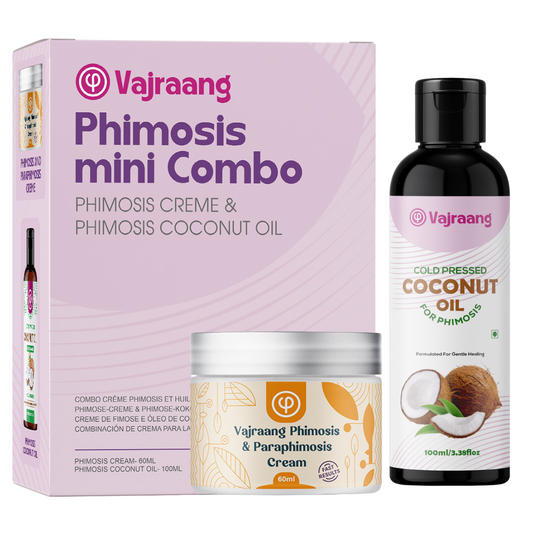
Option 2: Coconut Oil
Extra Virgin Coconut Oil
Natural lubricant, antifungal, and anti-inflammatory support during ring sessions
Coconut oil is widely used during phimosis treatment and correctly so, but for specific reasons that are often misunderstood. The lauric acid in coconut oil has documented antifungal and antibacterial properties.[4] The oil provides excellent lubrication during ring sessions, reducing friction and preventing the micro-tears that lead to scar formation. It also helps maintain a clean local environment in an area that is difficult to hygiene when the foreskin cannot be fully retracted.
What coconut oil does not do is increase tissue elasticity at the phimotic band. It does not soften collagen. It does not repair microtears. It does not directly target the phimotic band tissue the way a steroid cream or a purpose-formulated therapeutic cream does. The men who use only coconut oil and expect it to treat phimosis on its own are using a lubricant as if it were a treatment. It is a valuable support tool, not the primary intervention.
What coconut oil does well
- Prevents friction burns and discomfort during ring sessions
- Antifungal protection: lauric acid inhibits candida overgrowth, a common issue in the foreskin environment
- Anti-inflammatory properties help calm post-session redness
- Supports healing of minor surface cracks and fissures
- Safe for indefinite daily use, no known adverse effects at this application site
What coconut oil does not do
- Does not increase foreskin elasticity or collagen remodelling
- Does not soften the phimotic band specifically
- Does not repair the microtears that accumulate from daily stretching
- Does not accelerate progress on the Kikiros scale as a standalone treatment
- Does not treat BXO or scar tissue
Use coconut oil for: ring session lubrication, post-session antifungal protection, and maintaining skin hydration between sessions. Use it alongside a therapeutic cream, not instead of one.
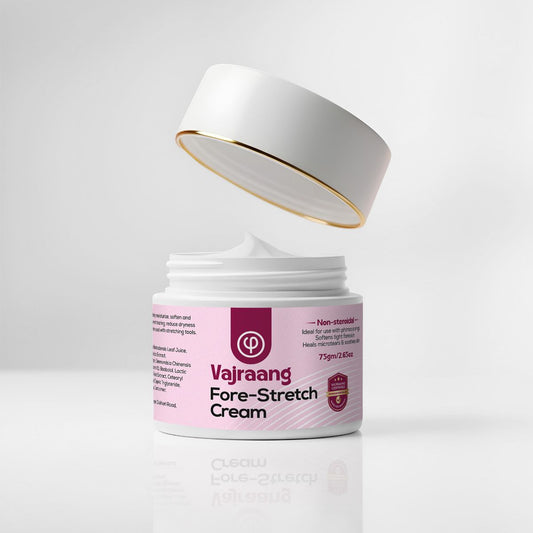
Option 3: Vajraang Fore-Stretch Cream
Vajraang Fore-Stretch Cream (100g)
Microtear repair, scar tissue softening, elasticity support for long-term daily use
The Fore-Stretch Cream addresses the most consistently underestimated problem in phimosis treatment: what happens to the tissue between sessions. Daily ring sessions create mechanical tension on the phimotic band. This tension produces micro-tears in the tissue. If those micro-tears heal as scar tissue, they make the phimotic band stiffer over time, not more elastic. This is the mechanism behind plateaus that persist despite correct daily practice.
The Fore-Stretch Cream is formulated with Centella Asiatica and Allium Cepa as key active ingredients. Centella Asiatica (also known as Gotu Kola) is a well-documented wound-healing and anti-fibrotic compound. Allium Cepa (onion extract) has evidence as an anti-scar agent, reducing the formation of hypertrophic scar tissue. Together they act as a post-session recovery and anti-fibrotic protocol for the phimotic band tissue.
Primary use case
- Applied after every session to the phimotic band to prevent micro-tears from healing as scar tissue
- For men who have experienced repeated minor tearing during stretching
- Long-term daily use throughout the treatment period with no duration limit
- Men who have stalled despite correct ring use: scar tissue accumulation may be the cause
When Fore-Stretch is most impactful
- Grades 4 to 2 where the tissue is actively expanding and microtear risk is highest
- When there is any history of cuts, fissures, or soreness after sessions
- Men with naturally drier or less elastic foreskin who notice the band becoming stiffer rather than softer over time
- After any period of overworking that caused visible redness or tearing
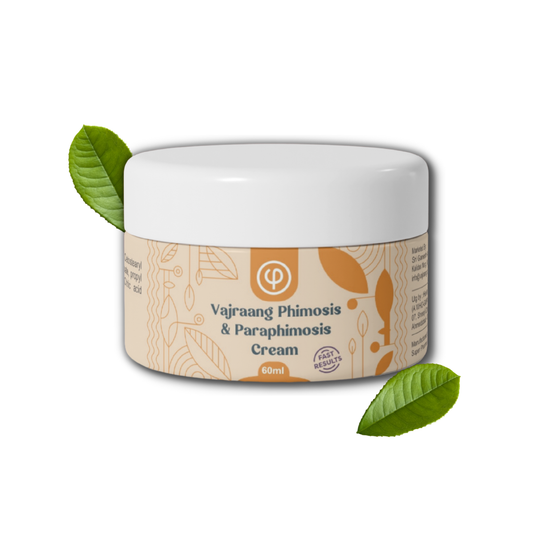
Option 4: Vajraang Phimosis and Paraphimosis Cream
Vajraang Phimosis and Paraphimosis Cream (60g)
Active loosening of the phimotic band, synergistic with daily ring sessions for accelerated progress
The Phimosis and Paraphimosis Cream is formulated to work synergistically with the mechanical action of the rings. Where rings provide the outward physical expansion of the phimotic band, the cream targets the tissue chemistry to accelerate how the band responds to that tension. Applied directly to the phimotic band before sessions, it prepares the tissue to yield to the mechanical stretch more effectively.
The formula works on both aspects of the phimosis problem: active foreskin loosening for the phimotic band, and cream support for paraphimosis prevention at Grade 1, where the foreskin passing behind the glans needs to move smoothly without causing inflammation or constriction. It is the primary daily working cream for men using rings, applied in the pre-session window after warming.
Primary use case
- Applied before ring sessions directly to the phimotic band, after the warm compress
- Daily use synergistic with ring progression across all grades
- Men at Grade 1 where smooth foreskin movement behind the glans is critical
- The standard working cream for active daily treatment
When P&P Cream is most impactful
- Grades 3 to 1, the primary active treatment window
- Men who have been stretching without any cream and experiencing slow progress
- Combined with rings for faster ring size advancement
- At Grade 1, applied before any retraction attempts to keep the band tissue conditioned
The Full Comparison Table

| Factor | Betamethasone | Coconut Oil | Fore-Stretch Cream | P&P Cream |
|---|---|---|---|---|
| Primary mechanism | Suppresses collagen synthesis, reduces inflammation. Temporary tissue softening. | Lubrication during sessions. Antifungal via lauric acid. | Repairs microtears. Anti-fibrotic action prevents scar hardening. | Actively loosens phimotic band. Works synergistically with ring tension. |
| Increases tissue elasticity | Short-term via collagen suppression. Reverses after stopping. | No | Yes by preventing scar tissue formation | Yes as the primary function |
| Repairs microtears | No | Minor surface healing only | Yes primary function | Partial |
| Duration of safe use | 4 to 8 weeks maximum. Atrophy risk with longer use. | Indefinite. No duration limit. | Indefinite. No duration limit. | Indefinite. No duration limit. |
| Prescription required | Yes in most countries | No | No | No |
| Risk of skin atrophy | Yes with extended use | None | None | None |
| Best applied | Directly to phimotic band. Twice daily for defined course. | Generously before sessions as lubricant. Small amount on glans. | After sessions to phimotic band and surrounding tissue. | Before sessions to phimotic band. After warm compress. |
| Grade range | All grades | All grades | All grades | All grades |
When to Use Which: The Scenario Guide

| Your situation | Recommended cream | Application timing |
|---|---|---|
| Just starting treatment. No complications. Grades 2 to 4. | P&P Cream before sessions. Coconut Oil during sessions. | P&P Cream after warm compress, before ring insertion. Coconut Oil on ring before insertion. |
| Experiencing soreness, minor tears, or redness that persists after sessions. | Fore-Stretch Cream after sessions. Coconut Oil during sessions. | Fore-Stretch Cream applied to the phimotic band and surrounding tissue immediately after each session. |
| Progress stalled for 4 to 6 weeks despite correct daily practice. | P&P Cream + consider betamethasone course from a doctor | Discuss betamethasone 0.05% with a urologist or GP for a defined 4 to 6 week course. Continue P&P Cream throughout. |
| Doctor prescribed betamethasone. What else should I use alongside it? | Coconut Oil during sessions. Fore-Stretch Cream after sessions. | Apply betamethasone as prescribed. Coconut Oil for lubrication during ring sessions. Fore-Stretch after sessions to prevent scar formation from the accelerated stretching. |
| At Grade 1. Full flaccid retraction, working toward erect retraction. | P&P Cream before sessions. Coconut Oil during sessions. | P&P Cream applied specifically to the residual tight band before the larger ring sessions. Critical for maintaining smooth foreskin movement at this stage. |
| Tight frenulum on the underside specifically. Downward pull during retraction. | FrenuFlex Cream for the frenulum specifically. P&P Cream for phimotic band separately. | Apply each cream to its specific target tissue. Read the frenulum breve guide for the full frenulum protocol. |
| Using rings for the first time. What is the minimum daily cream protocol? | Minimum: P&P Cream before + Coconut Oil during | P&P Cream on the phimotic band after warm compress. Coconut Oil on the ring before insertion. Two applications, both take under a minute. |
The Honest Comparison: Why Vajraang Cream Is Not "Just Marketing"
The concern men have is legitimate: every brand says their product is best. The way to evaluate whether a product is genuinely useful rather than generic is to ask what specific problem it is solving that the alternatives do not solve.
Betamethasone solves a specific problem: it temporarily suppresses collagen production to soften a stubborn phimotic band. It is clinically documented to do this. It also has a clear duration limit and documented risks at extended use. This is why no responsible protocol recommends it as a long-term daily cream.
Coconut oil solves a specific problem: lubrication during sessions and antifungal protection in the foreskin environment. It does these things well. It does not solve the collagen remodelling problem or the microtear recovery problem.
The Fore-Stretch Cream solves the problem that neither of the above addresses: what happens to the tissue between sessions. Daily mechanical stretching with rings creates microtears. Those tears can heal as elastic tissue (good) or as scar tissue (bad, creates stiffness). An anti-fibrotic application after sessions specifically addresses which way those tears heal. Centella Asiatica has documented anti-fibrotic activity. Allium Cepa has documented evidence as a scar-reducing agent. These are not generic moisturising ingredients.
The P&P Cream fills the role that betamethasone plays in the short-term clinical protocol but is formulated for long-term daily use with no duration limit. It does not have the acute potency of a 0.05% corticosteroid. It does have a sustainable mechanism that does not carry skin atrophy risk at extended use.
The honest recommendation: for most men, the practical daily protocol is P&P Cream before sessions, Coconut Oil during sessions, and Fore-Stretch Cream after sessions. Betamethasone enters the picture only when a doctor has assessed the situation and determined that a short-course corticosteroid is appropriate.

Vajraang Fore-Stretch Cream (100g): repair and anti-fibrotic, applied after sessions
Formulated with Centella Asiatica and Allium Cepa for microtear repair and anti-fibrotic protection. Apply to the phimotic band immediately after every ring session. Prevents micro-tears from healing as scar tissue. Daily use, no duration limit.
View Fore-Stretch CreamVajraang Phimosis and Paraphimosis Cream (60g): active loosening, applied before sessions
The primary working cream for the phimotic band. Apply directly to the tight band after the warm compress, before ring insertion. Works synergistically with ring tension to accelerate band expansion. All grades, daily use, no duration limit.
View P&P Cream20 questions · Kikiros grade · Ring size · Cream protocol for your stage
Begin the assessmentFrequently Asked Questions
Should I use betamethasone or Vajraang cream for phimosis?
They serve different roles. Betamethasone is a prescription corticosteroid appropriate for a defined 4 to 8 week course when a doctor has assessed your situation and determined it is appropriate. It works by temporarily suppressing collagen to soften the phimotic band. It carries skin atrophy risk at extended use. The Vajraang creams are designed for long-term daily use throughout a months-long treatment protocol with no duration limit. Most men do not need betamethasone if they are consistent with rings and Vajraang creams from the start. Betamethasone is appropriate when treatment has genuinely plateaued despite correct daily practice.
Does coconut oil help treat phimosis or just lubricate?
Coconut oil provides lubrication during ring sessions, antifungal protection via lauric acid, and minor anti-inflammatory support. It does not increase tissue elasticity, soften the phimotic band collagen, or repair microtears. It is a valuable session support tool, not a standalone treatment. Use it during sessions alongside a therapeutic cream, not instead of one.
What is the difference between the Fore-Stretch Cream and the Phimosis and Paraphimosis Cream?
Different functions, different timing. The Fore-Stretch Cream is applied after sessions to repair microtears and prevent scar tissue formation. Its key ingredients are anti-fibrotic: Centella Asiatica and Allium Cepa. The Phimosis and Paraphimosis Cream is applied before sessions to actively prepare the phimotic band tissue for the mechanical stretch. Most men benefit from both: P&P Cream before, Fore-Stretch after. The Fore-Stretch Cream becomes especially important for men experiencing soreness or repeated minor tearing.
My doctor prescribed betamethasone. Should I stop using Vajraang cream?
No. Use both. Apply betamethasone as your doctor prescribed, directly to the phimotic band. Continue using the Vajraang P&P Cream or Fore-Stretch Cream as the recovery application after sessions. Betamethasone does not repair microtears and does not provide antifungal protection. The Vajraang creams complement the betamethasone course rather than conflicting with it.
How long should I use betamethasone for phimosis?
The clinical protocol for topical betamethasone is 4 to 8 weeks, applied twice daily to the phimotic band alongside gentle stretching. Extended use beyond this window carries documented risks including skin atrophy, visible dilated capillaries, and local immunosuppression.[3] Do not continue beyond 8 weeks without a fresh assessment from the prescribing doctor.
I have been using only coconut oil and not making progress. What am I missing?
Coconut oil is a lubricant, not a tissue treatment. If you have been using only coconut oil with manual stretching, the phimotic band is not receiving the active preparation it needs before mechanical tension is applied. Add the Vajraang P&P Cream before sessions, applied directly to the phimotic band after warming. This is usually the single change that produces visible progress in men who have been using only coconut oil.
Can I use all the creams at the same time?
Yes, and the recommended protocol does use multiple creams across a single session. The sequence is: warm compress first, then P&P Cream on the phimotic band before ring insertion, then Coconut Oil on the ring for lubrication during the session, then Fore-Stretch Cream on the phimotic band and surrounding tissue after the session ends. Each is applied at a different moment for a different purpose. There is no conflict between them.
- Palmer LS, et al. The efficacy of topical betamethasone for treating phimosis: a comparison of two treatment regimens. Urology. 2005. PMID 18455770
- Topical corticosteroids for treating phimosis in boys. Cochrane Review. PMC 2024. PMC10809033. Source of the two-mechanism explanation of corticosteroid action on phimosis.
- Gul U, et al. Phimosis in Adults: Narrative Review of New Devices and Standard Treatments. PMC 2024. PMC10887835. Source of skin atrophy and extended-use risk data for corticosteroids.
- TRENPA. Coconut Oil for Penile Fissures. View source. Source of lauric acid and wound-healing properties of coconut oil.