You can retract flaccid. You cannot retract erect. This is not halfway treated. It is a specific, fully explained mechanical situation with a specific, calculable treatment target. This article gives you the physics of why it happens and the exact ring size you need to reach for free erect retraction.
This is one of the most common situations men report during phimosis treatment, and one of the least clearly explained anywhere. Most articles either ignore it or give generic reassurance. Neither helps. What helps is understanding exactly what changes between the flaccid and erect state anatomically, and therefore exactly what the phimotic band needs to achieve before erect retraction becomes possible.
The Exact Mechanical Reason It Happens

During an erection, blood fills the corpora cavernosa, the two expansion chambers that run the length of the penis.[1] The penis expands in both length and circumference. The circumference increase at the glans is what matters for phimosis: the glans head, which the foreskin must slide over, becomes significantly wider during erection than it is in the flaccid state.
The phimotic band is a fixed ring of tissue. Its current diameter is what it is regardless of your state. When flaccid, your glans is narrow enough to pass through your current phimotic ring diameter. When erect, the same glans has expanded to a diameter that now exceeds what the phimotic band can accommodate. The ring that was adequate when you were flaccid is no longer adequate when erect.
This is not a failure of treatment. It is physics. The phimotic band has a fixed diameter. The glans has a variable diameter. The gap between those two numbers determines whether retraction is possible in any given state.
Flaccid state
Glans at resting diameter
Glans diameter: At resting size. Smaller than erect. The corpora cavernosa contain low-pressure blood.
Foreskin demand on phimotic band: Must accommodate the resting glans diameter to retract. If your phimotic band opening is wider than the resting glans, retraction is possible.
Typical experience: Retraction feels possible, perhaps snug, but achievable. May require effort. The band stretches enough to let the glans through.
What this means for your grade: You are at Kikiros Grade 1, the most advanced pre-resolution stage. Full flaccid retraction with a tight ring behind the glans.
Erect state
Glans at maximum diameter
Glans diameter: Enlarged by 30 to 50% circumference increase as corpora cavernosa fill with high-pressure blood.[1] The glans is physically larger than when flaccid.
Foreskin demand on phimotic band: Must accommodate the enlarged erect glans diameter to retract. The same phimotic band that was adequate flaccid may now be too narrow for the expanded glans.
Typical experience: Retraction is impossible or causes pain. The foreskin pulls tight over the glans, sometimes causing constriction around the corona. The band that was enough when soft is not enough when hard.
What this means for your grade: Erect tightness at Grade 1 is a known and specific presentation. It resolves when the phimotic band is expanded past the erect glans diameter.
The physics in one sentence: to retract comfortably during erection, the phimotic band opening must be larger than the erect glans diameter, not the flaccid glans diameter. You have only solved the smaller problem so far. The larger target is measurably close.
The Numbers: What Changes Between States
Understanding the size difference between flaccid and erect gives you the concrete target to aim for.

| Factor | Flaccid state | Erect state | Why it matters for phimosis |
|---|---|---|---|
| Glans circumference | Resting size. Varies by individual. | 30 to 50% larger than flaccid in typical erection[1] | The foreskin must slide over a significantly larger structure during erection |
| Phimotic band diameter | Fixed. Does not change with erection. | Fixed. Same as flaccid. | A fixed ring must accommodate two different glans sizes depending on state |
| Skin tension on foreskin | Low. Foreskin skin is relaxed. | High. The expanded shaft pulls the foreskin taut at the base. | Erection places additional mechanical tension on the foreskin, reducing its available stretch margin |
| Retraction possible? | Yes, if band opening exceeds flaccid glans diameter | Only if band opening exceeds erect glans diameter (larger target) | This is exactly why the same man can retract in one state but not the other |
| Paraphimosis risk | Low when flaccid | High at Kikiros Grade 1. Never force retraction during erection at this stage. | The band that passes over the glans flaccid may trap behind it erect as the glans swells |
Your Exact Target: The Ring Sizes for Erect Retraction
The most practically useful information in this article: how many ring sizes beyond your current comfortable flaccid retraction you need to reach before erect retraction becomes possible.
This is an estimate based on average anatomy. Individual variation exists. The principle is consistent: for free erect retraction, you need the phimotic band to be meaningfully wider than the size at which you can currently retract flaccid. That gap is typically two to six ring sizes in the Vajraang kit.

| Current situation | Approx. current comfortable ring size | Target ring size for erect retraction | Remaining distance |
|---|---|---|---|
| Retract flaccid, just barely. Tight. Takes effort. | 24mm to 26mm | 28mm to 32mm | 4 to 6 ring sizes remaining |
| Retract flaccid comfortably. Snug but manageable. | 26mm to 28mm | 30mm to 34mm | 3 to 5 ring sizes remaining |
| Retract flaccid easily. Band feels loose. Snug erect. | 28mm to 32mm | 32mm to 36mm | 2 to 4 ring sizes remaining |
| Retract flaccid fully. Band just tight erect at corona. | 32mm to 34mm | 34mm to 38mm | 1 to 3 ring sizes remaining |
How to use this table: find the row that best describes your current flaccid retraction experience. The target column gives you the ring size range to work toward. When you can comfortably wear rings at that target size, erect retraction typically becomes possible. These are anatomical estimates. Your own numbers will tell you precisely.
Critical safety rule at this stage: do not attempt to force retraction during an erection. The foreskin can slide over the glans during erection and then trap behind it as the glans swells further. This is paraphimosis, a medical emergency requiring immediate manual reduction or clinical intervention. All stretching practice at this stage is done flaccid only. Read the full paraphimosis prevention guide before proceeding.
The Psychological Loop: Losing the Erection When Trying to Retract
A specific pattern appears repeatedly in accounts from men at this stage: they attempt retraction during erection, feel resistance and discomfort, become anxious, and lose the erection as a result. The next attempt starts with the anxiety already present, and the erection is harder to maintain. Over time this creates a conditioned association between retraction attempts and erection loss.
This is not a psychological disorder. It is a straightforward physiological feedback loop: pain or fear of pain activates the sympathetic nervous system, which constricts blood vessels and directly opposes the parasympathetic response required for erection.[2] One interferes with the other at a neurological level.

The Reinforcing Loop
Why erection loss during retraction attempts gets worse over time without a physical fix
Attempt retraction during erection. Feel the resistance of the phimotic band against the expanded glans. Physical discomfort or anticipation of pain.
Anxiety activates. Fear of pain, fear of paraphimosis, or frustration triggers the sympathetic nervous system. Adrenaline and cortisol rise.
Erection reduces or is lost. The sympathetic response constricts blood vessels, directly opposing the parasympathetic mechanism that produces erection. Not a psychological failure. A physiological one.
Loop reinforces. The association between retraction attempts and erection loss strengthens. The next attempt begins with pre-existing anxiety, making erection maintenance harder before even starting.
Stop attempting retraction during erection entirely until the physical target is reached. This is not avoidance. It is the correct clinical decision. There is no treatment benefit to forcing retraction at a ring size that cannot accommodate the erect glans. The only result is reinforcing the anxiety loop. Do not attempt erect retraction until your ring sessions reach the target size range in the table above.
When the physical restriction is resolved, the loop resolves with it. Once the phimotic band is wide enough to accommodate the erect glans comfortably, the anticipation of pain disappears. The anxiety loop has nothing to feed on. Erection maintenance during retraction becomes unremarkable.
The Protocol: What to Do From Here
You are at Kikiros Grade 1, the final grade before full resolution. Your treatment is not starting over. You are not in the middle of a long journey. You are in the final phase, with a measurable distance remaining and a specific ring size target to reach. The protocol is exactly the same as earlier grades, applied to the 28mm to 38mm ring range.
Identify your current comfortable ring size. The ring that enters with snug resistance, not pain, when flaccid. This is your baseline. Write it down with today's date. Your target is two to six sizes above this. The table above gives your specific range.
Continue the ring protocol in the larger sizes daily. Warm compress for two to three minutes. Cream applied to the phimotic band. Ring session thirty to forty-five minutes twice daily. At this grade, the focus is on the larger rings in the 28mm to 38mm range. These are the sizes that drive the last stretch of expansion needed for erect retraction.
Do not attempt erect retraction until you reach the target ring size. This is not optional advice. Attempting retraction at a ring size that cannot accommodate the erect glans produces only discomfort, the anxiety loop described above, and paraphimosis risk. It does not accelerate treatment. It works against it.
Monitor ring advancement as your primary progress indicator. At this stage, ring advancement from 28mm to 30mm, then 32mm, then 34mm, is your measurable weekly data. Each advancement narrows the gap between the band and the erect glans target. When you reach the target size and can wear it comfortably, test erect retraction gently once for a few seconds. Do not sustain it. Observe whether tightness has resolved.
Glans desensitisation runs in parallel. The glans has had limited exposure to air and touch during the flaccid-only phase. As you approach the target ring size, progressively expose the glans during sessions by allowing it to remain retracted for increasing periods in the flaccid state. This reduces the sensitivity that can add discomfort during the first successful erect retractions. Read the glans sensitivity guide for the full desensitisation protocol.
Check for frenulum involvement. Some men at Grade 1 find that even as the phimotic band is resolved, a tight frenulum on the underside continues to restrict erect retraction specifically. The frenulum is a separate structure and requires a separate protocol. If you have ever experienced tearing on the underside or downward pull during erection, read the frenulum breve guide.

Grade 1: Full flaccid retraction, tight erect
The phimotic band accommodates the flaccid glans. Does not yet accommodate the erect glans. Ring sizes in the 24mm to 32mm range. Paraphimosis risk is present if retraction is forced during erection. Treatment continues in the larger ring sizes.
Ring size reaches erect target range
Comfortable ring sessions at 32mm to 36mm range. The phimotic band is now approaching the diameter needed to accommodate the erect glans. First tentative erect retraction test is appropriate here, briefly and carefully, with attention to any residual tightness.
Grade 0: Full retraction in both states
The phimotic band is wide enough to accommodate the erect glans with no meaningful resistance. Retraction flaccid and erect both comfortable. The anxiety loop has no physical basis remaining. Paraphimosis risk eliminated. Maintenance protocol begins.
The larger rings in the Vajraang Kit: 28mm to 38mm, the Grade 1 range
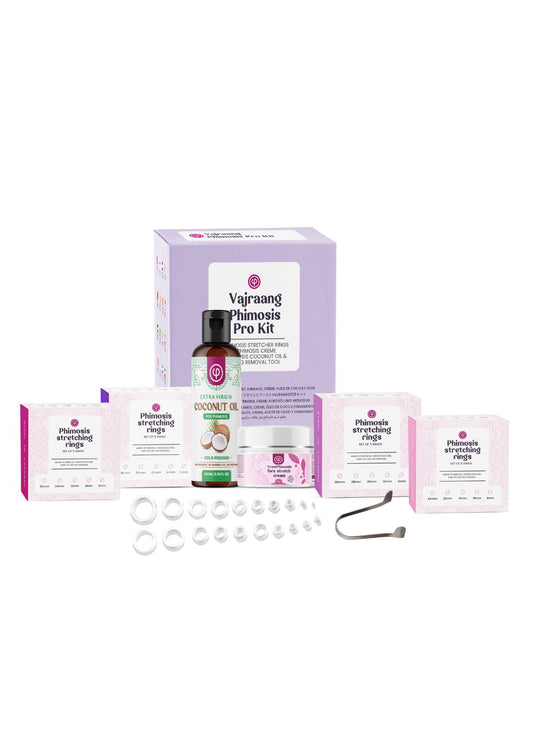
The Vajraang Rings Kit (3mm to 38mm, 20 sizes) contains the complete range needed for Grade 1 resolution. The larger rings in the 28mm to 38mm range are the specific sizes that drive erect retraction capability. Without a graduated kit that reaches 36mm to 38mm, the final phase of treatment has no measurable endpoint. Each size advancement narrows the gap between your current band diameter and the erect glans target.
View the Rings Kit20 questions · Kikiros grade · Erect target range · Week-by-week plan
Begin the assessmentFrequently Asked Questions
Why can I retract my foreskin when flaccid but not when erect?
Because the glans expands significantly during erection. Blood filling the corpora cavernosa increases penile circumference by 30 to 50% from the flaccid state.[1] The phimotic band is a fixed ring. When flaccid, your glans is narrow enough to pass through your current band opening. When erect, the same glans has expanded beyond what the band can accommodate. The same band, two different demands from the anatomy it must accommodate.
How much more do I need to stretch to retract when erect?
Typically two to six ring sizes beyond your current comfortable flaccid retraction size. This corresponds to approximately 4mm to 10mm of additional band diameter. The exact amount depends on individual anatomy. Use the target table in this article as a starting estimate, then adjust based on your own progress. When you can comfortably wear a ring in the 32mm to 36mm range, erect retraction is typically achievable for most men.
Should I try to retract during an erection to practise?
No. Not at this stage. Attempting retraction at a ring size that cannot accommodate the erect glans produces only discomfort, reinforces the anxiety loop that makes erection maintenance harder, and creates paraphimosis risk. It does not accelerate treatment. All stretching practice remains flaccid until you reach the target ring size range. At that point, a brief, gentle erect retraction test is appropriate to confirm resolution.
Why do I lose my erection when I try to retract?
Pain, the anticipation of pain, and anxiety activate the sympathetic nervous system. The sympathetic response constricts blood vessels, directly opposing the parasympathetic mechanism that produces and maintains erection.[2] This is a physiological feedback loop, not a psychological failure. It resolves automatically once the physical restriction is removed and the anticipation of pain disappears.
I can retract flaccid but there is still a tight ring behind the glans when erect. Which grade am I?
Kikiros Grade 1. Full flaccid retraction but a tight constricting ring behind the glans, specifically during erection, is the definition of Grade 1. It is the most advanced grade before full resolution (Grade 0). You are in the final phase of treatment, not a middle phase. The remaining distance is measurable in ring sizes and typically takes three to six weeks of consistent daily practice to close.
I can retract flaccid and erect but there is still tightness. What is happening?
Two possibilities. First, the phimotic band is still slightly undersized for your erect glans, causing tightness at the corona without fully preventing retraction. Continue advancing ring sizes in the 34mm to 38mm range. Second, the remaining tightness may be the frenulum rather than the phimotic band. If the tightness is specifically on the underside of the penis, read the frenulum breve guide to distinguish between the two causes.
How long does it take to go from flaccid retraction to full erect retraction?
For men already at comfortable flaccid retraction, the remaining distance to erect retraction typically takes three to six weeks of daily ring sessions in the 28mm to 38mm range. Individual variation is significant. Men who have been practising consistently and are already near the top of the target range may see resolution sooner. Men starting this phase with more distance to cover may take longer. Track your ring size advancement weekly to estimate your personal timeline.
- Bitsch M, et al. Biomechanics of male erectile function. J R Soc Interface. 2008;5(22):799-811. PMC2396202. Source of penile erection biomechanics and circumference expansion data.
- Dean RC, Lue TF. Physiology of penile erection and pathophysiology of erectile dysfunction. Urol Clin North Am. 2005;32(4):379-395. PMC1351051. Source of parasympathetic and sympathetic erection mechanism.
- Shahid SK. Phimosis in Children. PMC 2012. PMC3329654. Source of Kikiros grade definitions.
- Castiglione F, et al. Can circumcision be avoided in adult male with phimosis? PMC 2021. PMC8661253. Source of Kikiros Grade 1 clinical presentation context.