Phimosis is graded on a 1–5 scale based on how far your foreskin can retract. Knowing your grade determines which treatment is right for you, how long it will realistically take, and which Vajraang product matches your severity level.
The most asked question on every phimosis forum, every doctor's visit, and every 2am Google search is the same: "What grade am I?" The answer matters because Grade 1 and Grade 5 are completely different conditions that need completely different approaches. A man with Grade 1 mild tightness and a man with Grade 5 pinhole phimosis are not the same patient and treating them identically is why so many home treatment attempts fail.
This guide explains each grade precisely, what it feels like, what it means for your treatment, and exactly which Vajraang product fits your severity. If you haven't yet taken the self-assessment, that's the fastest way to know your grade but read this article first so you understand what the results mean.
The Phimosis Grading System — How It Works
The most widely used clinical grading system for phimosis is the Kikiros scale, which classifies retractability from Grade 1 (mild) to Grade 5 (complete non-retraction). Some clinicians use a reversed scale numbering the most severe as Grade 1, which causes confusion. Vajraang uses the system where Grade 1 is mildest and Grade 5 is most severe. This matches the most intuitive reading: the higher the number, the tighter the foreskin.
Grading is based on one thing: how far the foreskin retracts when the penis is erect. Flaccid retractability is less diagnostically useful because most men with phimosis can retract to some degree when flaccid. The real test is erect retractability.
The 5 Grades of Phimosis: Explained in Full
Full retraction possible — tight behind the glans
The foreskin retracts fully over the glans but feels tight or uncomfortable when pulled back, especially when erect. You can see the entire glans. You may notice a ring of tightness near the base of the glans when retracted.
What it feels like: A constricting sensation when the foreskin is pulled back. May cause mild discomfort during intercourse. Likely little to no pain at rest.
Treatment outlook: Excellent. Grade 1 responds very well to consistent manual stretching with cream. Most men resolve this within 6–8 weeks of daily practice.
Partial glans exposure — foreskin partially retracts
The foreskin retracts enough to expose part of the glans but not the full glans. The corona (the rim around the glans) is not fully visible. When erect, retraction is more restricted than when flaccid.
What it feels like: Noticeable resistance during retraction. Intercourse may be uncomfortable. The foreskin may feel tight during erection even without retraction.
Treatment outlook: Very good. Grade 2 is the most common grade presenting for treatment and the one with the highest conservative treatment success rate. The two-finger method works well here.
Meatus visible — glans not exposed
The foreskin retracts just enough to expose the urethral opening (meatus) but the glans remains covered. The foreskin tip appears noticeably narrowed.
What it feels like: Clear tightness even at rest in some cases. Erections may feel painful or constricted. Intercourse is typically uncomfortable. Hygiene becomes more difficult.
Treatment outlook: Good. Grade 3 benefits significantly from the combination of stretching rings and cream together. Progress is slower than Grades 1–2 but very achievable with consistency. Some men also benefit from the GlanPro tool for more targeted expansion.
Slight retraction only — meatus not visible
The foreskin barely retracts at all. The opening is visibly narrow. The meatus may be partially obscured. Ballooning during urination is common at this grade, the urine collects briefly under the foreskin before passing through the narrow opening.
What it feels like: Significant tightness. Erections are painful in many cases. Intercourse is very difficult or impossible. The glans is hypersensitive because it has never been exposed to contact.
Treatment outlook: Moderate. Grade 4 requires a more targeted approach, the GlanPro tool is particularly effective here because it allows precise, adjustable expansion at the tight opening. Rings may be too large initially. Start with GlanPro first, then transition to rings as the opening widens.
No retraction whatsoever — pinhole opening
The foreskin opening is extremely narrow, often described as a pinhole. No retraction is possible in any state. Urine passes through a very narrow stream, often with ballooning. The glans has never been exposed.
What it feels like: Complete absence of retractability. Significant urinary symptoms in many cases. Erections are painful. The glans is extremely sensitive to any touch. Men at this grade often feel significant anxiety and may have avoided medical consultation for years.
Treatment outlook: Requires the most patience, but is absolutely treatable without surgery in most cases. The Vajraang GlanPro tool was specifically designed for pinhole phimosis, starting with the smallest tip sizes and gradually progressing. Do not start with rings at Grade 5, the opening is too small. Begin with GlanPro, then transition to rings once the opening reaches approximately 10–12mm.
Which Vajraang Product Matches Your Grade
The most common mistake in phimosis treatment is using the wrong tool for the wrong grade. A man with Grade 5 pinhole phimosis attempting to use stretching rings will fail because they physically cannot fit. A man with Grade 1 tightness using the GlanPro tool is using a precision instrument where a simpler approach would do the job faster.
Grades 1–2 — Vajraang Fore-Stretch Cream + Manual Stretching
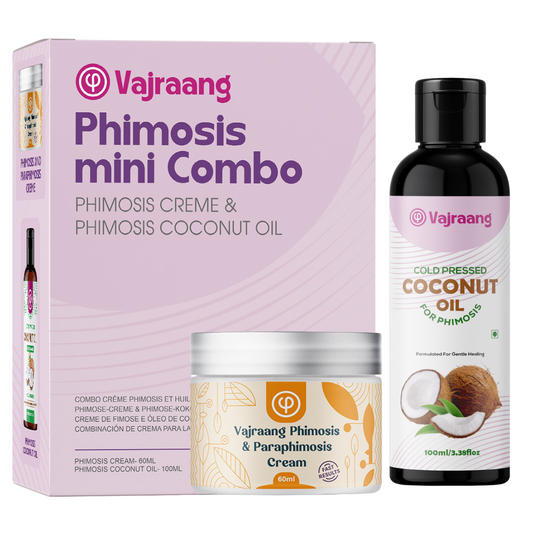
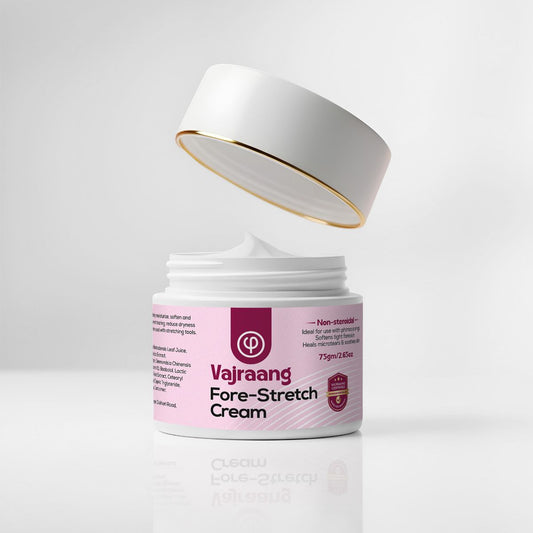
For mild-to-moderate tightness where the two-finger method works, the cream alone applied daily before stretching, is often all that's needed. The cream softens the phimotic band and dramatically improves the effectiveness of manual stretching. Read the complete 2-finger stretching guide for the full protocol.
View Fore-Stretch Cream →Grades 2–4 — Vajraang Phimosis Stretching Rings Kit (20 rings, 3mm–38mm)
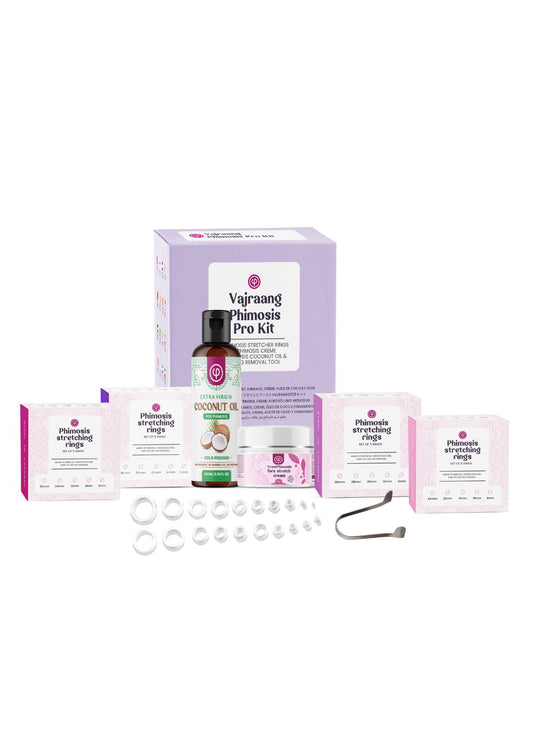
The complete 20-ring graduated system provides radial expansion of the foreskin opening, the most effective passive non-surgical treatment available. Each ring is worn for 30–60 minutes daily, progressing through sizes as the opening widens. Works best when combined with the cream. See the full guide on how to use the rings correctly.
View Rings Kit →Grades 4–5 (Pinhole) — Vajraang GlanPro Tool
The GlanPro tool was specifically designed for severe and pinhole phimosis where rings cannot physically fit. Made from medical-grade stainless steel with ergonomic ribbed handles, it provides precise and adjustable expansion exactly at the tight opening. Comes with the Phimosis cream included. Read the full GlanPro guide before starting.
View GlanPro Tool →Quick Reference — Grade to Treatment Table
| Grade | Retractability | Success Rate | Timeline | Recommended Product |
|---|---|---|---|---|
| Grade 1 | Full retraction — tight behind glans | 96% | 4–8 weeks | Cream + Manual |
| Grade 2 | Partial glans exposure | 90–96% | 6–10 weeks | Rings + Cream |
| Grade 3 | Meatus visible only | 85–90% | 8–12 weeks | Rings + Cream |
| Grade 4 | Slight retraction only | 75–85% | 10–16 weeks | GlanPro first → Rings |
| Grade 5 | No retraction — pinhole | Treatable | 12–20+ weeks | GlanPro only to start |
When Grading Alone Is Not Enough: The BXO Exception
The grade system describes retractability, it does not describe the cause of tightness. In most cases, phimosis is physiological: the foreskin simply hasn't loosened, or has tightened due to minor trauma or inflammation. Conservative treatment works well for this.
However, a specific skin condition called BXO (Balanitis Xerotica Obliterans) also known as lichen sclerosus, causes hardening and scarring of foreskin tissue. A man with BXO may present as Grade 3 or 4 on the retractability scale, but the underlying tissue is scarred rather than simply tight. This changes the treatment picture significantly: conservative stretching has limited effectiveness on scarred tissue.
How to spot BXO
- White or pale patches on the foreskin or glans, the most distinctive sign
- The foreskin feels hard or leathery rather than simply tight
- A white ring visible around the foreskin opening
- The skin appears shiny or crinkled rather than normal skin texture
- History of recurring balanitis or infections
If you see white, hardened, or shiny patches on your foreskin stop home treatment and see a urologist or dermatologist first. BXO requires confirmed diagnosis before any treatment decision is made. This is the one situation where the grading system alone is insufficient.
If there is no BXO present, your grade is the primary guide to treatment. Most men presenting for treatment do not have BXO, but it is important to rule it out, particularly at Grades 4 and 5.
What to Do Once You Know Your Grade
-
Step 1 — Confirm your grade
Use the descriptions above or take the Vajraang self-assessment quiz for a more structured grading. The quiz asks 20 specific questions and gives you your starting ring size, recommended protocol, and recovery timeline.
-
Step 2 — Read the treatment article for your grade
Grades 1–3: start with the 2-finger stretching guide and the rings guide. Grades 4–5: start with the GlanPro guide.
-
Step 3 — Understand your timeline
Read the week-by-week treatment timeline so you know what to expect — and what normal progress looks like versus a plateau.
-
Step 4 — Know what pain is and isn't normal
Mild tension during stretching is expected. Sharp pain is a signal to stop. Read what to do if you experience pain during stretching before your first session.
-
Step 5 — Start today
The only thing that doesn't work is waiting. Every week of consistent practice is a week of progress toward resolution. Every week of waiting is not.
20 questions · Your starting ring size · Step-by-step recovery plan
Take the Quiz →A Note on Grade 4 and 5: The Psychological Weight
Men with severe phimosis (Grades 4–5) carry a disproportionate psychological burden. Research confirms that 69% of men with persistent phimosis experience significant anxiety, and 46% avoid romantic relationships entirely because of the condition.[4]
For men who have never seen their glans, who have lived with pinhole phimosis through adolescence and adulthood, the psychological dimension of this condition is as real as the physical one. The shame, the avoidance, the quiet resignation to a permanent limitation, none of this is weakness. It is the documented consequence of an undertreated condition surrounded by silence.
Grade 5 is treatable. It takes longer. It requires more patience. But men with pinhole phimosis have resolved their condition completely with the GlanPro tool and consistent practice. Read the full article on the psychological effects of phimosis if this resonates.
Join the Vajraang Private Recovery Channel on Telegram Grade-specific support, real progress stories, and daily protocol guidance. Free to join. →Frequently Asked Questions
How do I know what grade of phimosis I have?
Grade is determined by how far your foreskin retracts when erect, not flaccid. Grade 1 retracts fully but feels tight. Grade 5 (pinhole) cannot retract at all. Use the grade descriptions above or take the free Vajraang self-assessment quiz for a more precise result including your starting ring size.
Can all grades of phimosis be treated without surgery?
Yes, in the vast majority of cases, including Grade 5 pinhole phimosis. Clinical studies report 85–96% success with conservative treatment for Grades 1–3.[1] Grades 4–5 require more time and the right tool (GlanPro), but are absolutely treatable. Surgery should be considered only after a genuine 12-week conservative trial has failed, or when BXO is confirmed.
What is the difference between Grade 4 and Grade 5 phimosis?
Grade 4 allows very slight retraction, the foreskin moves marginally but the meatus is not visible. Grade 5 (pinhole) has essentially no retractability and a visibly very narrow opening. The practical difference for treatment: Grade 4 can sometimes begin with small stretching rings, while Grade 5 almost always needs to start with the GlanPro tool before rings can be used.
Why does grade matter when choosing a product?
Because the physical opening of the foreskin determines which tool can fit. A Grade 5 pinhole opening cannot accommodate even the smallest stretching ring (3mm) in many cases — the GlanPro tool is designed precisely to create the initial opening that makes ring use possible. Using the wrong tool for the wrong grade either fails to work or risks injury.
Does my grade affect how long treatment will take?
Significantly. Grade 1–2 men typically see resolution in 4–10 weeks with consistent practice. Grade 3 takes 8–12 weeks. Grade 4–5 typically requires 10–20+ weeks. Read the full article on treatment timelines for a detailed week-by-week breakdown.
What is BXO and how do I know if I have it?
BXO (Balanitis Xerotica Obliterans) is a skin condition causing hardening and scarring of foreskin tissue. Signs include white or pale hardened patches on the foreskin, a shiny or leathery texture, and a white ring at the opening. BXO changes the treatment approach, conservative stretching has limited effectiveness on scarred tissue. If you suspect BXO, see a urologist or dermatologist for confirmed diagnosis before starting any home treatment.
My foreskin retracts when flaccid but not when erect. What grade is that?
This is typical Grade 2–3 phimosis. The foreskin is sufficiently elastic to retract in the flaccid state but the erect penis creates more tension that the phimotic band cannot accommodate. This is one of the most common presentations and responds very well to stretching rings combined with cream. Take the self-assessment quiz to confirm your precise grade and get your starting ring size.
I have Grade 5 pinhole phimosis. Can I really treat this at home?
Yes. The Vajraang GlanPro tool was specifically designed for pinhole phimosis. It provides precise, adjustable expansion at the very tip of the foreskin, something rings cannot do when the opening is too narrow for them. Many Vajraang customers with Grade 5 pinhole phimosis have reached full foreskin mobility using the GlanPro tool before transitioning to rings. It takes longer and requires more patience, but it works.
- Zampieri N, Corroppolo M, Camoglio FS, et al. Phimosis: stretching methods with or without application of topical steroids? J Pediatr. 2005;147(5):705–6. PMID 16291369 →
- Orsola A, Caffaratti J, Garat JM. Conservative treatment of phimosis in children using a topical steroid. Urology. 2000;56(2):307–310. PMID 10925099 →
- Osmonov D, Hamann C, Eraky A, et al. Preputioplasty as a surgical alternative in treatment of phimosis. Int J Impot Res. 2022;34(4):353–358. PMC9117135 →
- Onset of sexuality is impaired in young men with persistent congenital phimosis. ScienceDirect, 2022. View study →
- Morris BJ, Matthews JG, Krieger JN. Prevalence of phimosis in males of all ages: systematic review. Urology. 2020;135:124–132. PMID 31655079 →