No. Age does not close the window on treating phimosis without surgery. Conservative treatment with topical cream and stretching is an option for adult men at any age, and clinical literature confirms this explicitly for men across all adult age groups.[1]
The question gets asked every day. A man in his mid-twenties who has lived with phimosis since adolescence. A man in his thirties who only just learned the condition had a name. A man in his forties who assumed surgery was the only remaining option. All of them asking the same thing: is it too late?
The answer, in almost every case, is no. Foreskin tissue responds to consistent mechanical stretching regardless of age. The mechanism that makes treatment work — tissue expansion through gradual, repeated tension — does not have an upper age limit. What changes with age is not whether treatment works, but the specific factors affecting your individual situation.
This article covers what the research actually says about phimosis treatment in adults, what changes at different ages, and exactly what to do whether you are 18 or 55.
What the Research Actually Says About Adults
The most important piece of evidence for any adult reading this comes from a 2024 narrative review published in PMC — the first paper specifically reviewing all available treatment options for phimosis in the adult setting.[1] The conclusion was clear: conservative treatment is a valid option for adult phimosis, including topical steroid application and mechanical stretching devices.
This is not a paediatric finding being applied to adults. It is a specific conclusion about adult men. The study reviewed 288 publications and identified conservative treatment as a genuine first-line option for adults with phimosis.
The German National health information platform, InformedHealth (published by the NCBI), states this directly: topical steroid treatment for phimosis is "also recommended for older boys and men" who still have the condition.[2]
The mechanism is straightforward. Skin that is under consistent, gentle tension expands by growing new cells through a process called tissue expansion. This process — cellular differentiation and mitosis in response to mechanical force — happens in adult tissue just as it does in younger tissue. It is not age-dependent. It is effort-dependent.
The primary variable in phimosis treatment is not age. It is the cause of the tightness. Physiological phimosis (tissue that is simply tight) responds well to conservative treatment at any age. Pathological phimosis caused by scarring or BXO (Balanitis Xerotica Obliterans) requires a different assessment regardless of age.
At Every Age: What Changes and What Does Not
Age affects certain practical factors in phimosis treatment. It does not affect whether conservative treatment is possible. Here is an honest breakdown for each stage of adult life.
Late teens and early twenties
Many men in this age group have physiological phimosis that simply did not resolve on its own during adolescence. The tissue is elastic and responsive. This is arguably the most favourable time to start conservative treatment — the foreskin has not been affected by years of repeated micro-trauma, and the tissue responds quickly to consistent practice.
The biggest barrier at this age is not the body. It is the shame and silence that prevents a young man from acknowledging the condition exists and starting treatment. If you are 18 and reading this, you have not missed anything. You are at the best possible starting point.
Conservative treatment: excellent candidateMid to late twenties
The age at which most men first seriously address phimosis, often prompted by a relationship or by reaching a point where the condition can no longer be quietly managed. The tissue is still highly responsive. Success rates for conservative treatment at this age are consistent with the general published data: 85 to 96% with cream and stretching combined.
Men in this age group often carry years of accumulated anxiety about the condition. Addressing that psychological weight alongside the physical treatment matters. Read the article on phimosis and psychological effects if this resonates.
Conservative treatment: excellent candidateThirties
Men in their thirties who present with phimosis often fall into one of two groups. The first group has had lifelong phimosis that was never treated. The second group has developed acquired phimosis in adulthood, usually from repeated micro-trauma, scarring from previous balanitis, or skin conditions.
For lifelong physiological phimosis in this age group, conservative treatment remains effective. The tissue takes slightly longer to respond than it would in a younger man, but the mechanism is intact. Realistic timelines shift from 8 to 12 weeks toward 10 to 16 weeks for Grades 2 to 4.
For acquired phimosis caused by scarring, the picture is more nuanced. If scar tissue is present, conservative stretching may have limited effectiveness on the hardened areas. A urologist assessment is worthwhile to distinguish the cause before committing to a protocol.
Conservative treatment: good candidate (assess cause first)Forties, fifties, and beyond
Men in this age group are consistently surprised to learn that conservative treatment is still an option. Many have assumed for years, sometimes decades, that their only route was surgery. The clinical evidence does not support that assumption.
The 2024 adult phimosis review referenced above specifically addresses older men, noting that conservative treatment with topical steroids remains a valid option across all adult age groups. The one caveat for older men: if diabetes is present, blood sugar control matters significantly because poor glycaemic control can cause recurrent infections that worsen phimosis and impair healing.
Timelines are longer. The tissue responds more slowly. The practice needs to be more consistent and more patient. But the mechanism remains intact.
Conservative treatment: valid option — longer timeline requiredThe Two Types of Adult Phimosis That Affect Treatment
Age matters less than cause. The most important question is not how old you are but why your foreskin is tight. There are two fundamentally different types of adult phimosis, and they follow different treatment paths.
Physiological (congenital) phimosis in adults
This is phimosis that has been present since birth and simply never resolved. The tissue is tight but healthy and elastic. There is no scarring, no hardening, no skin condition involved. This type responds well to conservative treatment at any age. The stretching mechanism works because the tissue is biologically normal — it is just tight.
This is the most common type presenting in adult men, particularly in India where circumcision is not routine practice and many men reach adulthood without ever having sought treatment.
Pathological (acquired) phimosis in adults
This is phimosis that developed in adulthood due to an identifiable cause. Common causes include repeated infections (balanitis or balanoposthitis), scarring from forceful retraction attempts, skin conditions such as lichen sclerosus, and diabetes-related tissue changes.
Pathological phimosis is more complex because the underlying tissue may be scarred or hardened. Conservative stretching has limited effectiveness on scar tissue. The most important distinction to rule out is BXO (Balanitis Xerotica Obliterans), which causes a characteristic white hardening of foreskin tissue and requires specialist assessment.
If your phimosis developed in adulthood after a period of normal retractability, or if you notice white or hardened patches on the foreskin, see a urologist before starting home treatment. Read the guide on understanding your phimosis type for more detail.
Most adult Indian men with phimosis have the physiological type — lifelong tightness that was never treated. This type responds well to conservative treatment regardless of age. The question is not whether treatment works. The question is how long you are willing to be consistent.
Four Beliefs That Keep Men From Starting
Age anxiety in phimosis follows a predictable pattern. The same beliefs appear across every age group, and every one of them is either wrong or significantly overstated.
"If it hasn't resolved by now, it never will without surgery."
Physiological phimosis does not resolve on its own in adults because there is no developmental process continuing to loosen the tissue. But "not resolving on its own" is not the same as "not responding to treatment." The tissue remains elastic and responds to consistent mechanical stretching. Resolution requires deliberate practice — not time.
"Adult skin is too rigid to stretch."
Skin undergoes tissue expansion in response to mechanical tension throughout life. This is the biological principle behind wound healing, reconstructive surgery, and every stretching-based medical protocol. Foreskin tissue in a healthy adult responds to the same mechanism. Physiological phimosis is characterised by tight but healthy tissue — not rigid or inelastic tissue.
"I've had this for so long that the condition must be too severe to treat without surgery."
Duration is not the same as severity. A man who has had Grade 2 phimosis for fifteen years still has Grade 2 phimosis. The length of time you have had the condition does not change the grade, does not change the tissue type, and does not change the likelihood of conservative treatment working. The grade determines the treatment path. Not the years.
"I'm too old — the healing will take too long and not be worth it."
A 45-year-old man who achieves full retraction after 16 weeks of treatment has decades of improved intimacy, hygiene, and confidence ahead of him. The investment in treatment time is the same regardless of age. What changes is how many years of benefit follow. Starting at 45 still gives you thirty or more years of improvement. The question is not whether it is worth it. It always is.
The Protocol for Adult Men: What Changes at Different Ages
The core protocol for phimosis treatment is the same at 20 as it is at 50. What changes is the timeline and the pacing. Adult tissue responds to the same mechanisms with a slightly longer schedule.
What stays the same at any age
- The core protocol: warm compress, topical cream, stretching, log progress
- Session length: 10 to 15 minutes once or twice daily
- The importance of consistency over intensity
- The tools: stretching rings for Grades 2 to 4, GlanPro tool for severe or pinhole grades
- The cream application timing and amount
What to adjust for men over 35
- Extend your assessment window. Do not evaluate whether treatment is working at 4 weeks. Evaluate at 8 to 10 weeks. Adult tissue takes longer to show visible change.
- Prioritise the warm compress step. Warmth matters more at older ages because tissue is slightly less elastic at baseline. Two to three minutes every session, without exception.
- Be more conservative with pressure. The difference between productive tension and counterproductive force is smaller as tissue ages. Mild tension. Never pain.
- Check for diabetes if you have recurrent infections. Elevated blood sugar impairs tissue healing and can cause repeated balanoposthitis that worsens phimosis. If this applies to you, blood sugar management is part of treatment.
The one situation where age does change the answer
If your phimosis developed in adulthood after previously normal retractability, and you notice white or hardened patches on the foreskin or around the opening, this pattern suggests acquired pathological phimosis or BXO rather than the physiological type. In this situation, conservative treatment may have limited effectiveness regardless of age. A urologist assessment comes first.
Where to Start Based on Your Grade
Grade determines the starting point. Age determines the timeline. Together they determine which product to use and what realistic progress looks like for you specifically. Read the complete grade guide if you are not sure where you fall.
Grades 1 to 2 at any age — Vajraang Cream with manual stretching
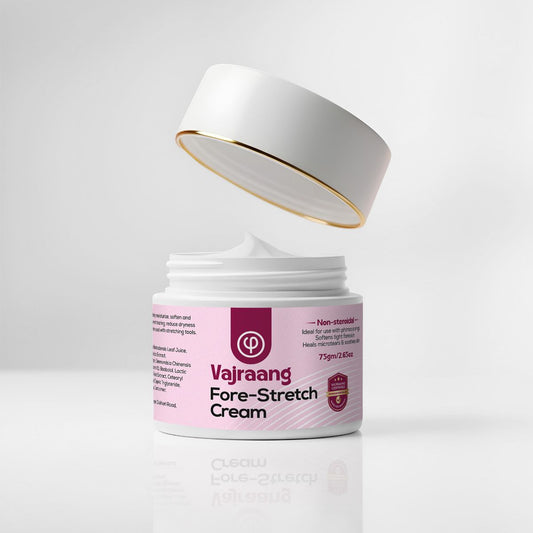
For mild to moderate tightness, consistent daily application of the Vajraang cream alongside the two-finger stretching method is the starting point. The cream softens the phimotic band and significantly improves how the tissue responds to mechanical stretching. Read the full two-finger stretching guide before your first session.
View the Cream →Grades 2 to 4 at any age — Vajraang Rings Kit (20 rings, 3mm to 38mm)
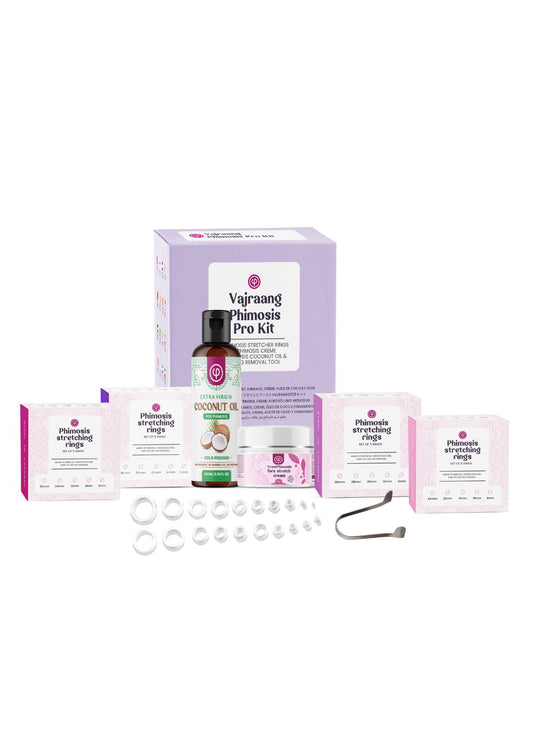
The complete graduated ring system is the most effective passive stretching method available. Each ring provides consistent radial expansion at the phimotic band for 30 to 60 minutes daily. Progress is tracked by ring size advancement. For men over 35, expect progression to be slightly slower than the typical timelines, but the mechanism is unchanged. See the rings usage guide for the full protocol.
View the Rings Kit →Grades 4 to 5 (severe or pinhole) at any age — GlanPro Tool
For very tight or pinhole phimosis where rings cannot physically fit, the GlanPro tool provides the precise, adjustable expansion that rings cannot deliver at the initial stage. Made from medical grade stainless steel and designed specifically for foreskin stretching, it comes with cream included. Read the GlanPro guide for correct usage from the start.
View the GlanPro Tool →The One Honest Note for Men Who Have Waited a Long Time
If you have lived with phimosis for ten, fifteen, or twenty years, there is something worth acknowledging before you begin.
The condition does not get harder to treat just because you have had it longer. But the habits of avoidance and management that accumulate over years sometimes do. Men who have spent a long time quietly working around phimosis often carry significant psychological weight alongside the physical condition. Anxiety about intimacy. Avoidance of medical care. A deeply embedded belief that nothing will change.
That belief is understandable. It is also incorrect.
A 2022 study found that 69% of adult men with persistent phimosis experience significant anxiety and 46% avoid romantic relationships entirely because of the condition. These are not personal failures. They are documented responses to years of carrying something alone in silence. When the physical condition resolves, the psychological weight does not automatically lift with it. Give that process the same patience you give the stretching practice.
The men who succeed at conservative treatment, at any age, share one quality: they treat the condition as something that can change, rather than something they simply have. That shift is more powerful than any cream or tool.
Want faster results? Join the Vajraang Private Recovery Channel Grade-specific protocols, real progress updates, and daily support. Free to join. →20 questions · Your starting ring size · Step-by-step recovery plan
Begin the assessment →Frequently Asked Questions
Can adults treat phimosis without surgery?
Yes. Conservative treatment with topical steroid cream and mechanical stretching is a valid option for adult men at any age. A 2024 narrative review published in PMC — the first review specifically examining adult phimosis treatment — confirmed conservative treatment as a genuine first-line option across all adult age groups.[1] The German national health platform InformedHealth also states explicitly that topical steroid treatment is recommended for older boys and men with persistent phimosis.[2]
I am 35 and have had phimosis my whole life. Is it too late?
No. Physiological phimosis in a 35-year-old man responds to the same conservative treatment as in a younger man. The tissue mechanism that makes stretching effective does not expire with age. What changes is the timeline: expect 10 to 16 weeks for Grades 2 to 4, rather than the 8 to 12 weeks typical for men under 30. The treatment works. It requires more patience.
Does age affect success rates for phimosis treatment?
Not significantly for physiological phimosis. The published success rates of 85 to 96% for topical steroid cream combined with stretching come from broad populations and are not age-restricted. What age affects is the timeline to resolution and the likelihood of acquired pathological causes being present. If you have had phimosis since birth and have no BXO or scarring, the success rate data applies to you regardless of your current age.
What is the difference between physiological and pathological phimosis in adults?
Physiological phimosis is congenital and lifelong: the foreskin has always been tight and the tissue is healthy but simply did not loosen. It responds well to conservative treatment. Pathological phimosis developed in adulthood due to scarring, infection, or a skin condition such as BXO. The scarred tissue responds less predictably to stretching. If your phimosis developed after a period of normal retractability, or if you see white hardened patches, seek a urologist assessment before starting home treatment.
I have had phimosis for over 20 years. Does the duration affect treatment?
No. Duration and severity are separate things. A man with Grade 2 phimosis who has had it for 20 years still has Grade 2 phimosis. The years do not change the tissue type, the grade, or the likely effectiveness of conservative treatment. They do, however, often accumulate significant psychological weight alongside the physical condition. Give both dimensions the attention they deserve during treatment.
Should I still try conservative treatment if a doctor has already recommended circumcision?
Yes, in most cases. A recommendation for circumcision without a prior trial of conservative treatment represents an incomplete consultation according to clinical guidelines. You are entitled to request a trial of topical cream and stretching before agreeing to surgery. Surgery remains available after conservative treatment has been genuinely tried. The reverse is not true. Read the full guide: My Doctor Told Me I Need Circumcision — Do I Have To?
At what age should I stop trying conservative treatment and opt for surgery?
Age is not the criterion. The criterion is whether conservative treatment has been genuinely tried for a minimum of 12 weeks with consistency and has shown no measurable improvement. If that is the case, a urologist consultation is the appropriate next step — not because of age but because of genuine treatment resistance. The presence of BXO is the one situation where surgery may be appropriate without a conservative trial regardless of age.
I have diabetes and phimosis. Does that change anything?
Yes, partially. Diabetes-related elevated blood sugar can cause recurrent infections (balanoposthitis) that worsen phimosis and impair tissue healing. Blood sugar management is an important part of treatment in this case. Conservative stretching can still be effective, but the infections need to be controlled first. See a urologist for assessment of both the phimosis and the underlying condition before beginning a home stretching protocol.
- Gul M, De Luca F, Farhan B, et al. Phimosis in Adults: Narrative Review of the New Available Devices and the Standard Treatments. Uro. 2024;14(1). PMC. PMC10887835 →
- InformedHealth.org. Phimosis: Overview. NCBI Bookshelf. NBK326437 →
- Zampieri N, Corroppolo M, Camoglio FS, et al. Phimosis: stretching methods with or without application of topical steroids? J Pediatr. 2005;147(5):705–6. PMID 16291369 →
- Orsola A, Caffaratti J, Garat JM. Conservative treatment of phimosis in children using a topical steroid. Urology. 2000;56(2):307–310. PMID 10925099 →
- Morris BJ, Matthews JG, Krieger JN. Prevalence of phimosis in males of all ages: systematic review. Urology. 2020;135:124–132. PMID 31655079 →
- Onset of sexuality is impaired in young men with persistent congenital phimosis. ScienceDirect, 2022. View study →